‘Art of the Islands’ by Michelle Brown

img_1727Michelle Brown is a prolific author, yet every additional book comes with new insights explained in her inimitable user-friendly way, and this volume is no exception. It covers the period from c. 450–1050 AD, that is from the departure of the Romans to the incoming of the Normans and their conquest. The book is beautifully produced and the illustrations particularly clear and detailed, and it brings together aspects of manuscripts, stone-work, armour, metalwork, jewellery and architecture as well as archæological finds and hoards.


ship_burial_helmetAfter an Introduction, the book is divided into five sections, starting with the period 300–700. This includes artefacts from the Sutton Hoo burial mound, a belt buckle from Kent, the St Augustine Gospels, and the Franks Casket. The influence of figures such as Benedict Biscop, Bede, King Æthelbert of Kent and his wife Bertha are also considered.


lindisfarne_gospels_folio_139r-1The importance of the identity of the Anglo-Saxons in their art and artefacts at this time is brought out in the next chapter in a consideration, amongst others, of manuscripts from the early eighth century such as the Lindisfarne Gospels and the Codex Amiatinus. The influence of Bede and stylistic aspects led Michelle Brown to date the Lindisfarne Gospels later than the previously accepted date of 698. Her conclusion is that they were completed by Bishop Eadfrith from 710–20, the unfinished nature of a few pages in the book likely to have been due to his death in 722.


staffordshire_hoard_annotatedThe Staffordshire Hoard was found in 2009 near Lichfield, and, at over 3,500 items, is the largest hoard of Anglo-Saxon gold. In the next chapter in the book on Southumbrian art, this hoard is linked to the crypt at Repton and the ‘Tiberius’ group of manuscripts. This group includes the Vespasian Psalter, the Book of Cerne, the Tiberius Bede and the magnificent Stockholm Codex Aureus.


athelstanWhat happened in art after the defeat of the Vikings is covered in the following chapter where Bede’s Life of St Cuthbert is shown here being presented by King Æthelstan to the saint himself. Their rather swarthy appearance is due to the discolouration of white pigment. Art in Wales, Alba (Scotland mainly), Cornwall, Ireland and other places is considered with illustrations of many local stone crosses, and also a delightful set of stone caryatids from Fermanagh in Ireland and the glorious Cross of Cong.


2006bc6621_jpg_lThe fusion of Insular, Carolingian, Ottonian, Byzantine and Scandinavian influences are brought together in the last chapter which deals with art from the mid-tenth century onwards.The Benedictional of St Æthelwold, the Ramsey and Harley Psalters, the Sutton Isle of Ely brooch and a grave slab from St Paul’s Cathedral all show those influences.


For anyone who loves manuscripts this is a wonderful book, produced by the Bodleian Library Publishing, as it places script, illumination, and page design and decoration in the context of what else was happening in other forms of art at various stages in this fascinating period of British history. It is very highly recommended.


An unknown book by Graily Hewitt


CIMG2727
Graily Hewitt was a truly great craftsman. Not only did he write the ‘Illuminating’ section in Edward Johnston’s seminal work ‘Writing & Illuminating, and Lettering’ but his work is astonishingly fine, particularly his gilding on gesso. The gesso is usually laid exquisitely, with spine-tingling serifs, and the burnish of the gold leaf enviable. I have been shown and have been given permission to feature this book which has been previously unknown.


CIMG2734The book is a hand-written copy of the poem ‘John Gilpin’ and was written for the granddaughter of Dr R A Holmes (see right). He was a student of Graily Hewitt and they corresponded until the Dr’s death. Because his granddaughter had shown an interest in what the Dr did as a hobby (although a very competent ‘hobbyist’!) he left his desk and all his tools, materials and equipment to her. During the war, vellum, parchment, gold and pigments were scarce, and the granddaughter was asked if Graily Hewitt could have some of the calligraphy materials that had been left to her. She agreed and this book was sent to her as a thank you.


CIMG2735The accompanying letter written by Graily Hewitt is delightful, and starts ‘Dear Little Maid’. It explains that the book is ‘mere writing’ but what ‘your grandfather and I used to love and practice together’. He goes on to say that her grandfather ‘was getting on famously, though his profession kept him too busy to enjoy doing it often’.


CIMG2737Graily Hewitt then says that it is in thanks for her ‘unselfishness in parting with all his beautiful parchment and gold and most of his pens, that I, who loved him very much, might have them to continue in the work we both so much cared for … I can hardly get such things nowadays; and I shall be so glad to have them for their reminder of him and the craft he loved, as well as his continued kindness to me’.


CIMG2728 (1)The illumination is just perfect, even looked at under magnification.


CIMG2729The poem is written on parchment, not vellum, being Graily Hewitt’s preferred writing surface (for the different between the two see here), and so the writing isn’t always as sparklingly fine as it can be on vellum, but it shows the hand of a great master nevertheless.


CIMG2723The book is bound in fine red leather on raised bands, evident on the spine. The title is gold blocked and there is a simple narrow gold border around the front and back covers.


CIMG2725At the back of the book the name of the binder is recorded as ‘W H Smith’. This is now a newsagents, bookseller and stationers in the UK. It may seem strange to think that they once did such a fine binding. Dr Christopher de Hamel of Corpus Christi College, Cambridge has told me that Douglas Cockerell used to do most of the binding for W H Smith, so perhaps this slim volume has a link with another great man.

Cobblers and cordwainers

220px-Cordwainer_statue_Watling_StreetThe nursery rhyme says it all ‘Cobbler, cobbler mend my shoe’! It is cordwainers, not cobblers, who make shoes from new leather, and although the name is slightly archaic, it is still used by the Worshipful Company of Cordwainers, who received their first ordinance in 1272. There is even a Cordwainer ward in London which is where most of the cordwainers lived, and where this statue is now situated. The Cordwainers’ College in London existed as a separate entity until the year 2000 when it was incorporated into the London College of Fashion.


Cordwainers-crestThe name comes through Anglo-French ‘cordonnier’ as a corruption of cordouan leather from Córdoba in Spain. This leather was made from Musoli goatskin which was tawed with alum; it was in demand throughout Europe for the best shoes, particularly the red leather. In fact images of the goat are on the shield of the Cordwainers’ Company and as their crest.


Paris_psaulter_gr139_fol7vThe high-grade status of the red leather of skin from Córdoba is emphasised in this Byzantine image of King David. Only someone wealthy and really important such as a king would wear red leather shoes.


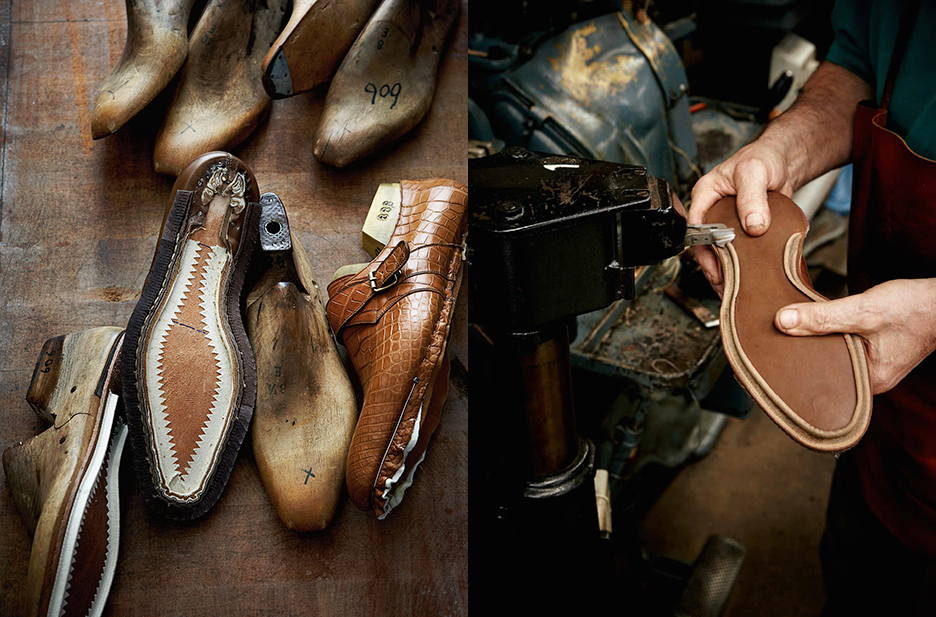
220px-Lohgerber_1880Making shoes today follows a similar pattern. Leather is first soaked in water to clean and soften the skins. The hair was then removed and the skin ‘bated’ by pounding dung into the skin or soaking in dung, urine and animal brains. For this reason tanneries were usually on the outskirts of towns as this was a stinky business! Vegetable tanning uses bark, often oak bark, and the hides are used mainly for luggage and furniture, strong shoes and belts.


Clicking-Image-1bThen the hides are taken to the clicker who cuts the uppers for the shoes, This is a skilled job because thin and damaged areas of skin need to be avoided, and the best sections of the skin used for the appropriate parts of the shoe. The craftspeople are called clickers because of the sound of their knives against the metal edged-binding of the patterns for the shoes.
hqdefaultThe uppers are then closed or sewn together, a process which includes decoration, punching holes and fitting eyelets.


imgresThen the soles and heels are cut from leather, the heels being built up from a number of layers.


2.aaCJ1187The next stage is lasting, where the tops of the shoes take shape over a wooden last, and are attached to the inner sole.


_benchmade_04After a number of other processes finally the uppers are attached to the soles and heels, the shoes finished, polished and packed ready to be sold. This is a short film of how shoes are made.

Glittering Gilders

IMG_1469We had an early start at the London University Palæography International Summer School to ensure that the images of mediæval beasts were transferred on to prepared vellum, and the adhesive laid before a break for coffee. It was marvellous that everyone managed this, but hard and concentrated work!


IMG_1472It’s tricky to get a whole miniature gilded and painted in a day, especially as most people have no experience whatsoever in even handling a paintbrush, let alone one with so few hairs, so we chose the miniatures carefully, focusing on animals from bestiaries. This lovely peacock is the copy, not the bestiary original!


IMG_1470Here is a fearsome bonnacon without its usual defence mechanism (look it up!), with two soldiers holding spears and shields.


IMG_1474And here two elegant goats, with the ‘original’ being copied in front. Notice the shine of real gold leaf on the vellum!


FullSizeRenderA red elephant and a blue dragon are fighting here perhaps producing dragon’s blood!


FullSizeRender 2And a knight on a horse is hunting a boar here.


IMG_1475Two strongly coloured pigs!


IMG_1477 2And lastly a white horse fit for a princess!

Comments from students included:

Excellent!

Best class of the week.

A detailed, practical workshop.

I thought the teaching was excellent; all the explanations were very clear and thorough. Patricia was very encouraging throughout the course and I never felt that I wouldn’t achieve something worthwhile. 

I have thoroughly enjoyed this course.

Next year, 2017, I shall be teaching a one-day practical calligraphy course for LIPSS, and the year after that, 2018, there will be a repeat of this course. Meanwhile, in 2017 I am thinking of running the three-day gilding and painting a mediæval miniature course again here in Sevenoaks, probably over the late May Bank Holiday. Look out for details and dates in my newsletters. This was the one last year.

Book of Hours greetings cards

squirrelSo many people have asked about the Wolf Hall Book of Hours that I produced for the BBC series, and whether copies of the pages are available that I’ve had some little cards printed. They feature on the front the cutest red squirrel with long pointed ears that look like a punk haircut, and on the back of the card a little grey rabbit, and are A7 in size (11 by 7 cm; 4 by 2 and 3/4 inches).


IMG_1383They’re ideal for little thank yous, greetings for birthdays and anniversaries, and tiny cards for children. I’m selling them in packs of 5 with white envelopes for £3.50p per pack (70p per card), with postage on top but at cost as they go into an A6 envelope. For the UK it’s £1 per pack p+p, £2 p+p for Europe and £2.50 p+p for elsewhere. (For multiple packs, please contact me.) Everyone, of course, gets their name written calligraphically on the envelope!


Please contact me through my website for details of how to pay, or through my usual email address.

Royal Regiment of Artillery Tercentenary scroll

Celebrating the 300th Anniversary of their founding, Wiltshire based Royal Artillery welcomed her Majesty The Queen, Captain-General of The Royal Artillery, to Knighton Down in Larkhill, Wiltshire to attend a Review of the Royal Regiment of Artillery today 26 May 2016. Raised by Royal Warrant in 1716, the Royal Regiment of Artillery marked a historic three centuries on 26 May 2016. Commonly known as the ‘Gunners’, the Royal Artillery provides firepower to the British Army. The Queen has been Captain-General of The Royal Regiment of Artillery since 6 February 1952. During her visit The Queen received the Royal Salute and inspected the Armoured Parade, before being presented with the Captain-General's Baton by the youngest member of the Royal Artillery, 17 year old Gunner Mischa Kalis. The Captain General’s Baton was launched on a circumnavigation of the globe on 1 May 2015 from the Royal Arsenal in Woolwich. Known as the UBIQUE (meaning everywhere) 300 project, it has undertaken a relay of 60 expeditions through 30 countries, ranging from adventure training to battlefield studies to sports tours: over one thousand men and women from the Royal Artillery have taken part in its travels. Photographer - Cpl Daniel Wiepen RLC (Army Photographer) - Army Headquarters NOTE TO DESKS: MoD release authorised handout images. All images remain Crown Copyright. Photo credit to read - Cpl Daniel Wiepen RLC (Phot) richardwatt@mediaops.army.mod.uk shanewilkinson@mediaops.army.mod.uk Richard Watt - 07836 515306 Shane Wilkinson - 07901 590723

Celebrating the 300th Anniversary of their founding, Wiltshire based Royal Artillery welcomed Her Majesty The Queen, Captain-General of The Royal Artillery, to Knighton Down in Larkhill, Wiltshire to attend a Review of the Royal Regiment of Artillery on 26 May 2016.
Raised by Royal Warrant in 1716, the Royal Regiment of Artillery marked a historic three centuries on 26 May 2016. Commonly known as the ‘Gunners’, the Royal Artillery provides firepower to the British Army.
The Queen has been Captain-General of The Royal Regiment of Artillery since 6 February 1952.
During her visit The Queen received the Royal Salute and inspected the Armoured Parade, before being presented with the Captain-General’s Baton by the youngest member of the Royal Artillery, 17 year old Gunner Mischa Kalis.
The Captain General’s Baton was launched on a circumnavigation of the globe on 1 May 2015 from the Royal Arsenal in Woolwich. Known as the UBIQUE (meaning everywhere) 300 project, it has undertaken a relay of 60 expeditions through 30 countries, ranging from adventure training to battlefield studies to sports tours: over one thousand men and women from the Royal Artillery have taken part in its travels.
Photographer – Cpl Daniel Wiepen RLC (Army Photographer) – Army Headquarters

As a jobbing scribe, I rarely know what is going to be my next commission, but the one for the Royal Regiment of Artillery was one of the most interesting.


The years 2016 marked the Regiment’s tercentenary, and to celebrate this a group of their soldiers circumnavigated the globe. They took with them a specially commissioned titanium baton, inside of which was the vellum scroll being presented to The Queen on the right.


CIMG2324


While the wording was being finalised, I experimented with the initial suggestions, knowing that the text would have to be quite small as the scroll needed to fit inside the baton. A tercentenary is a major achievement so I thought that a few flourishes here and there would add to the celebratory feel.

CIMG2327I was also looking forward to painting the Royal Arms and the badge of the Royal Regiment of Artillery. I made a few paste-ups to try to get the balance the best I could.


CIMG2335I then heard that the requirement was for no flourishes and a black and white image so adjusted things accordingly. The space below the citation on the right was for the signatures (see first picture above) which were written during the circumnavigation by Commonwealth Artilleries sending their greetings to The Queen, who is the Captain General of the Gunners.


CIMG2342It was a challenge to draw the Royal Arms and the Regiment’s badge as small as it needed to be, and the wheel of the gun carriage was actually just over 5 mm in the end. Despite the vellum going round the world, it arrived back to me for stretching in remarkably good condition – all credit to the soldiers who were involved.


Celebrating the 300th Anniversary of their founding, Wiltshire based Royal Artillery welcomed her Majesty The Queen, Captain-General of The Royal Artillery, to Knighton Down in Larkhill, Wiltshire to attend a Review of the Royal Regiment of Artillery today 26 May 2016. Raised by Royal Warrant in 1716, the Royal Regiment of Artillery marked a historic three centuries on 26 May 2016. Commonly known as the ‘Gunners’, the Royal Artillery provides firepower to the British Army. The Queen has been Captain-General of The Royal Regiment of Artillery since 6 February 1952. During her visit The Queen received the Royal Salute and inspected the Armoured Parade, before being presented with the Captain-General's Baton by the youngest member of the Royal Artillery, 17 year old Gunner Mischa Kalis. The Captain General’s Baton was launched on a circumnavigation of the globe on 1 May 2015 from the Royal Arsenal in Woolwich. Known as the UBIQUE (meaning everywhere) 300 project, it has undertaken a relay of 60 expeditions through 30 countries, ranging from adventure training to battlefield studies to sports tours: over one thousand men and women from the Royal Artillery have taken part in its travels. Photographer - Cpl Daniel Wiepen RLC (Army Photographer) - Army Headquarters NOTE TO DESKS: MoD release authorised handout images. All images remain Crown Copyright. Photo credit to read - Cpl Daniel Wiepen RLC (Phot) richardwatt@mediaops.army.mod.uk shanewilkinson@mediaops.army.mod.uk Richard Watt - 07836 515306 Shane Wilkinson - 07901 590723

Photographer – Cpl Daniel Wiepen RLC (Army Photographer) – Army Headquarters

This is another picture of The Queen inspecting the scroll, which has here been stretched over a piece of wood to keep the vellum flat.


IMG_1377 (1)

However, this wasn’t the end of the story for me. I had the thrill of being invited to lunch, the special parade and the presentation of the baton and the scroll to The Queen. Being in the Royal Enclosure really was something special and we were this close to Her Majesty! It was a absolutely joyous day with families involved in watching marching bands, tug of war, gun carriage racing, a concert, and ending in fireworks. It was all such a treat and quite a change for me as I usually sit in my quiet workroom scratching away with a quill on vellum.


CIMG2704The signatures of the Commonwealth Artilleries are now in place and the vellum has been stretched.


20160504_180230_resizedThe Gunners with swords drawn standing guard over the baton.

St Clement Danes and the RAF

st-clement-danes-geographSt Clement Danes, an ‘island’ church in the Strand in London, is thought to be situated on a previous church founded by the Danes in the ninth century; it is named after St Clement, patron saint of mariners. The other island church is St Mary-le-Strand and they are both situated on islands in the middle of the road. The building was completed to a design by Sir Christopher Wren in 1682 but was badly damaged by the Blitz of London during the Second World War, and it was only restored in 1958. There is some dispute at to whether this is the ‘Bells of St Clements’ in the nursery rhyme ‘Oranges and Lemons’ or whether that church is St Clement Eastcheap.


641DFA22_5056_A318_A87B4CAFF2FA914CThe church is the Royal Air Force Church mainly as a result of an appeal for funds for the rebuilding after the war. The Welsh slate floor of the church is engraved with the badges of over 800 RAF groups (stations, squadrons etc), and there is also a memorial to the Polish airmen who died in service during the war.

3-st-clement-danes-book-of-remembrance11Along the aisles are ‘shrines of remembrance’ – illuminated cases which display the Books of Remembrance for those who lost their lives in service to the country. There are eleven books displayed; the first book, nearest the altar, contains the names of those who died before the RAF came into being. Books two to nine have the names of those who lost their lives in the second World War, book ten contains the names from VJ day to 2013, and the eleventh book is from April 2013. The pages are turned every day by a turner that looks a little like a military sword (see on the left in this photo).

Sheila WatersIn my book The Art and History of Calligraphy (published 2017) I feature one of these pages with names written by the great Sheila Waters (se right). Sheila was one of a handful of the best scribes in the country, including Dorothy Mahoney, who took part in this immense project supervised by Alfred Fairbank. Sheila said: ‘I wrote a lot for the St Clement Danes’ Roll of Honour. It amounted to about 33,000 names over a period of six years, during which I had two children so it had to be fitted in with changing nappies and feeding babies!’ Her, and the other scribes’, precise rhythmic script is a fitting memorial to those who gave the ultimate sacrifice.


Wang Dongling at the V&A, London Craft Week 2016

Wang DonglingThe second London Craft Week proved to be even better than the first, if that’s possible. At the launch at the Victoria and Albert Museum, the world-renowned great Chinese calligrapher, Wang Dongling, demonstrated his great art in front of hundreds of people. It must have been nerve-wracking! His ‘writing surface’ was a huge sheet of clear glass placed vertically, and he used some rather sticky paint and a large brush. Because it was clear glass the distraction of the movement of people through the glass and the flashes of the cameras as he wrote must have been difficult to overcome.


Wang Dongling writingI managed to film the whole calligraphic artwork – The Way that can be Spoken – from beginning to end on my iPad. Here it is. It is a bit wobbly, and other people got in the way, but it’s pretty much the sequence from beginning to end. As someone who has also demonstrated calligraphy to the public, and been ‘the hand’ for film and television, I have some knowledge of how nerve-wracking this can be – making sure that the letter-forms are correct, lively and true, with no going back to make adjustments. However, I have to hasten to add that my efforts are nothing like the scale of this, nor at this standard (and, of course, not Chinese writing!).


Ewan and WangStraight after the inaugural London Craft Week last year we were talking about the plans for London Craft Week 2016, and the contribution of the Heritage Crafts Association, taking into account the fact that the first anniversary is often thought of as ‘paper’. I suggested one of the great ‘performance art’ Chinese calligraphers, who I have seen writing with brushes as big as mops on huge pieces of paper on the floor. This would be such a dramatic event for the launch of London Craft Week 2016, especially as this year it had an international theme*. However, who to choose? Who was considered to be the best? I asked the person who I knew would know – Ewan Clayton MBE. I was delighted when I found out that it was possible for him to be invited to the event and I ensured that he was introduced to the great man – two renowned calligraphers, one from the east and one from the west. This is the photo I took of them both.

lcw-prince_charles_02*It was a throwaway comment from The Prince of Wales at the launch of the very first London Craft Week back in February 2015 at the Art Workers’ Guild that gave rise to the international theme of this year’s event. Here he is with letter cutter Lida Cardozo Kindersley at that occasion. As he was leaving the event, The Prince of Wales turned to Philippa Hobson, London Craft Week Programme Director, and me (I was there for the Heritage Crafts Association, one of the four Strategic Partners) and he said ‘What about international craft?’, and Philippa replied in a flash – ‘That’s next year’, and indeed it was!

Orpiment – it glisters but isn’t gold

220px-KellsFol032vChristEnthronedOrpiment, the word derived from the Latin Auripigmentum, and also known as king’s yellow, has been known since Roman times, and was a treasured pigment used in mediæval manuscripts. Its particular value was because it was yellow and could not only replace gold when it was unavailable or too expensive, but because orpiment was similar to gold and that was the colour that was considered to be near-divine and, like God, indestructible.


260px-LindisfarneFol27rIncipitMattCennino Cennini in in his Libro dell’ Arte of the 15th century, describes orpiment as ‘a handsome yellow more closely resembling gold than any other colour’. It was used in books like the Book of Kells (see above) which has no gold. The Lindisfarne Gospels does have a few areas of gold, but orpiment was the colour used for yellow as in this incipit to Matthew (right).


orpiment19052a
Other yellows available at the time were not nearly as lasting as orpiment; saffron, urine and fish bile – all forms of yellow – were all far more fugitive. Orpiment could not be ground too finely, though, or it lost its egg yolk golden colour, but the advantage of this was that by being still a little crystalline, it actually glistened and reflected the light.


imgresIt is, though, one of those colours where it is very wise not to lick brushes. Orpiment is arsenic trisulphide, and Cennini said ‘beware of soiling your mouth with it, lest you suffer personal injury’! Wise words.

It wasn’t a colour that mixed well, though. Sulphur in the pigment reacted with copper in verdigris, and the lead in ceruse, or white lead. In the 17th century, Cornelius Jansen wrote: ‘Orpiment will ly faire on any culler, except verdigres, but no culler can ly faire on him, he kills them all’.

Graily Hewitt – some little seen works

CIMG2526Graily Hewitt was one of the first students to be taught calligraphy by Edward Johnston at the beginning of the last century and did a great deal to advance the knowledge and practice of gilding using gesso and leaf gold. In fact he wrote the ‘Illumination’ section in Johnston’s book – Writing, Illuminating and Lettering, as well as writing his own book Lettering for Students and Craftsmen, published in 1930. Graily Hewitt taught at both Camberwell School of Art as well as the Central School, continuing at the latter until the 1920s and 1930s.


CIMG2528Graily Hewitt did a great deal, indeed it could be said was crucial, in the revival of gilding on gesso. He wrote out the Rubaiyat of Omar Khayyam using a different gesso recipe for each page. This was bound into a small volume, and with it he gave details of the recipes and the results in another volume. Both are now in the British Library.


CIMG2529The examples of his work here are the ‘Christmas cards’ he sent to one of his pupils, ‘the Doctor’. Each is written on parchment, sheepskin, and are in black and red only. However most, as with this one on the right, are striking! It is surprising how often something simple is the best solution and black and red work so well together.


CIMG2530These pieces were written by Graily Hewitt in his twilight years – he died aged 88 on 22nd December 1952 – and was writing up until his death. Although the lettering is strong, not all of it, in my view, is totally successful – the ‘h’ and ‘e’ overlap on the right being a case in point. I would suggest that it brings a density to the design which is not balanced elsewhere, although it does avoid a too long line, which may have been the intention.


CIMG2531However, other designs and letter combination are just delightful. The balance of this lightweight cross on the right and the text, resulting in a shield-shape is particularly pleasing.


CIMG2532And the placing of the red dots making a tastefully decorated cross with the tail of the ‘g’, in this piece that I used in my free online newsletter, neatly balances the red letter ‘w’ on the first line. You can also see Graily Hewitt’s neat and legible handwriting at the bottom.


I intend to write more on Graily Hewitt in a future blog and newsletter.