Tag Archives: Limbourg Brothers

December in the Très Riches Heures of the Duc de Berry

The ‘Labour’ of the Month for December in the Très Riches Heures of the Duc de Berry is boar hunting as evidenced by this rather gory image of a dead boar lying in its own blood having been hunted by dogs. It is hardly a labour apart from for the huntsmen involved! Three men are really struggling to control the dogs even though the boar is clearly dead.


The huntsman on the right in the miniature is blowing a horn, which is attached to his body by thick leather straps going over his right shoulder; he is supporting the horn in his right hand which is awkwardly twisted round (it would be more natural if it was held with his hand the other way round so that his thumb is the most visible with the tips of his fingers indicating the grip). In his other hand he holds a long spear. The white highlights really do stand out on the horn, and also the single dot as the white of his eye. He is wearing a fur hat, a glorious blue tunic which looks thick and warm and which is pulled in by a black belt, and he also wears a black undershirt with black boots.


December in the Tres Riches Heures of the Duc de Berry - huntsman in red tunic holding back a hunting dogOpposite him is a burly fellow with tousled hair and a bushy beard endeavouring to pull a brown dog which is wearing a heavy thick collar away from the boar. He is grabbing it by the ears, and the dog’s expression clearly shows that it is not enjoying the restraint! On the right of this huntsman’s red tunic are straps to leash the dogs. The dog’s teeth and the spittle from its mouth show how fierce these dogs are!
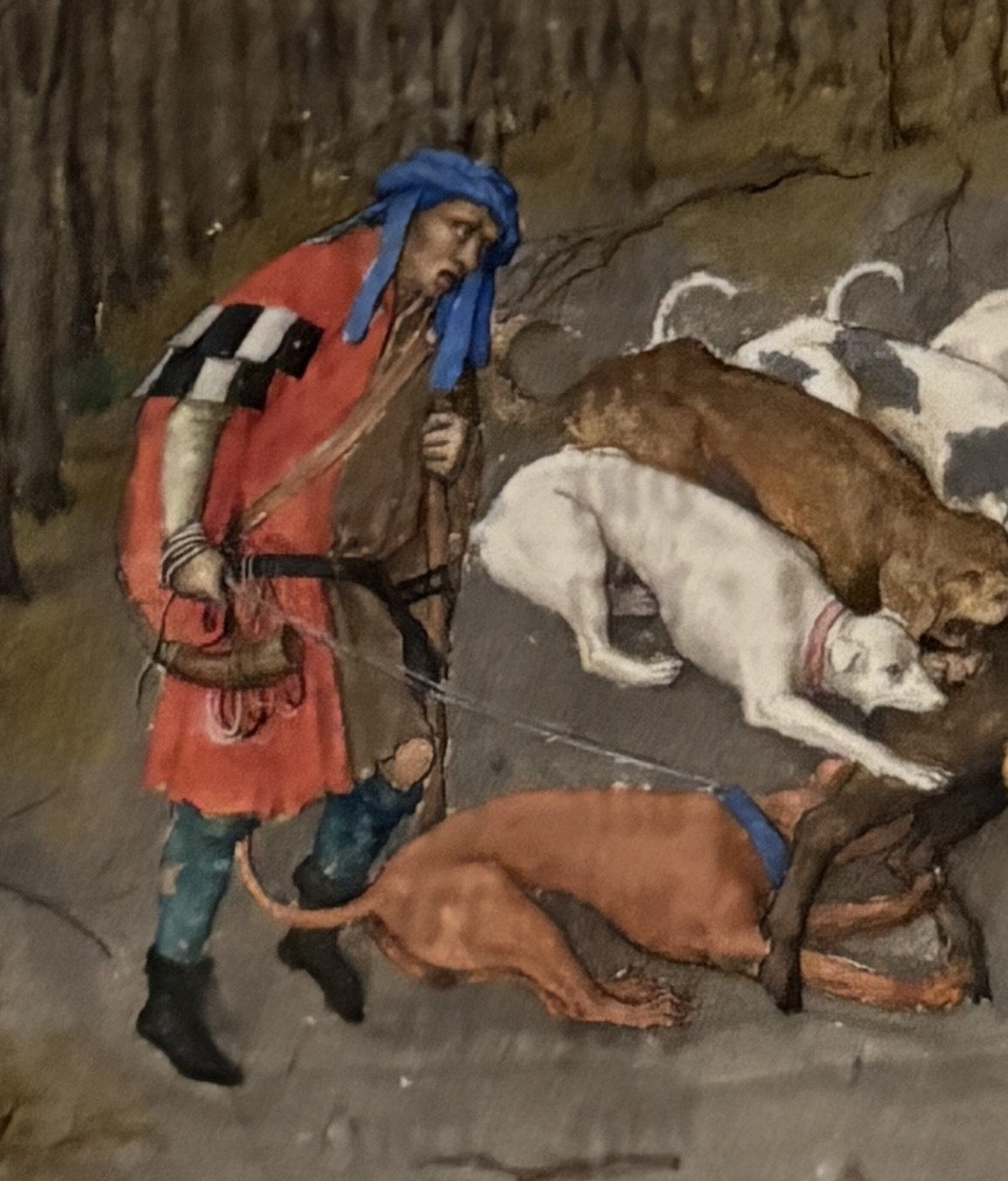


December in the Tres Riches Heures of the Duc de Berry - huntsman in red tunic holding a fierce dogThe third figure in this image is another huntsman looking rather disgruntled. He is wearing a blue hat with strips hanging over his shoulders, and his tunic is red and brown with a black and white check band over his shoulder; this tunic is held in with a black belt from which are hanging both his hunting horn and leashes for the dogs. He is holding on to a lead which is wound round his wrist and attached by a blue collar to a large brown dog clearly resisting being pulled away, as can be seen by the acute angle of its back legs and the way in which its collar is being pulled from its neck. Despite his two-coloured tunic his socks with large holes are falling down and his expression is one where he looks as if he wants to get back in the warm!

December in the Tres Riches Heures of the Duc de Berry - hunting dogs attacking a boarThe dogs look so vicious and I pity the poor boar who mustn’t have had much of a chance with this pack! They are beautifully painted, though, and the way in which they are pulling at the boar is depicted so well – there is a real tension there.


December in the Tres Riches Heures of the Duc de Berry - Chateau de VincennesAs with many of the images in this manuscripts, one of the Duc de berry’s castles is shown in the distance. This time it’s the Château de Vincennes, its towers stand proud over the canopy of winter trees.


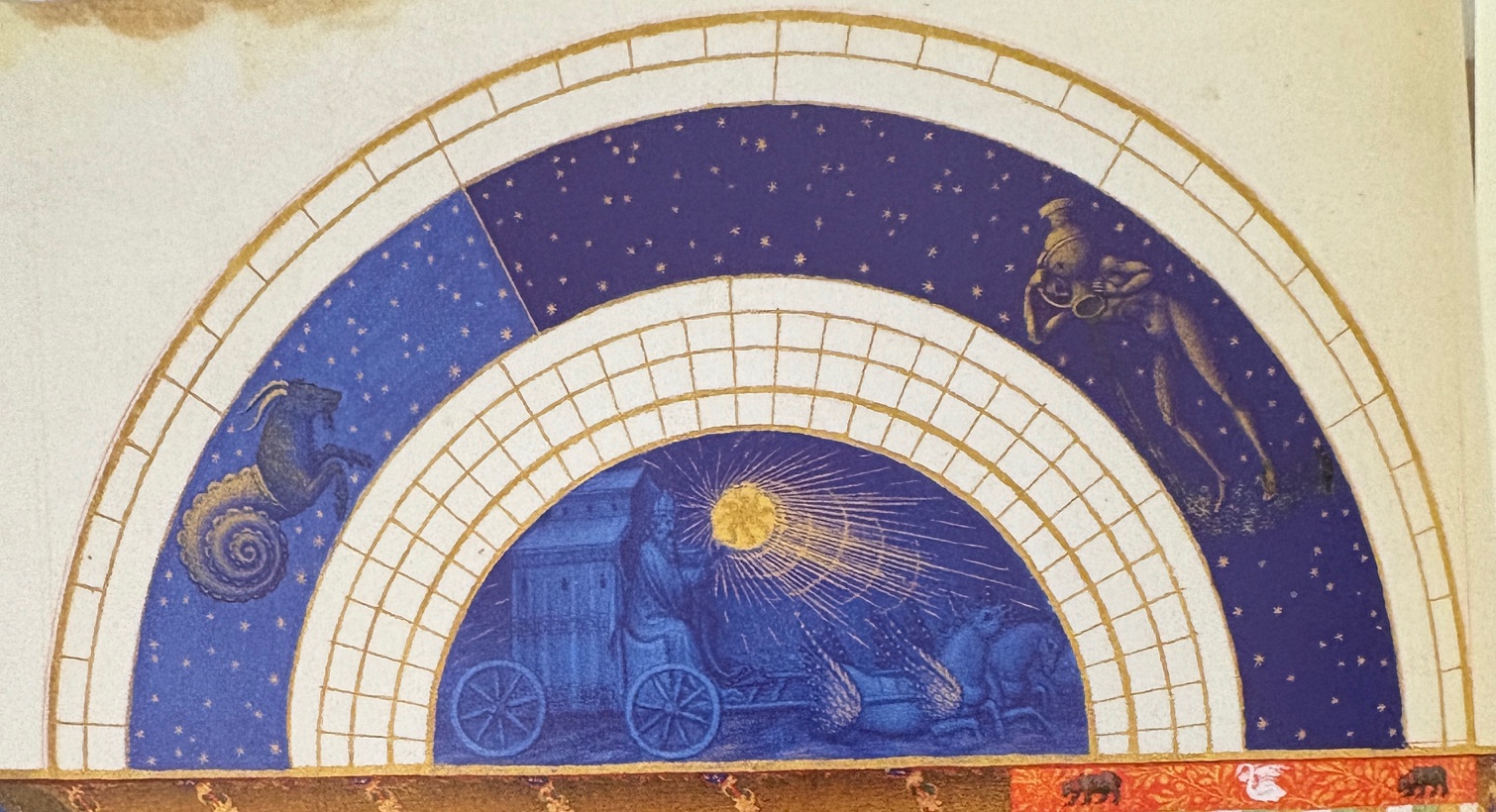
December in the Tres Riches Heures of the Duc de Berry - semi circle of depiction of the heavens at this monthEach month has a semi-circle of the heavens and astrological signs heading the main image, and December is no different. Sagittarius gives way to Capricorn and the sun chariot, drawn by four horses, relentlessly moves across the sky in the centre.

December in the Tres Riches Heures of the Duc de Berry - single pageYet again the incredible and inventive designs of the Van Lymborch Brothers are evident in this richly painted miniature.


For other months please click here for July, August, September, October, November, January, February
January in the Très Riches Heures of the Duc de Berry

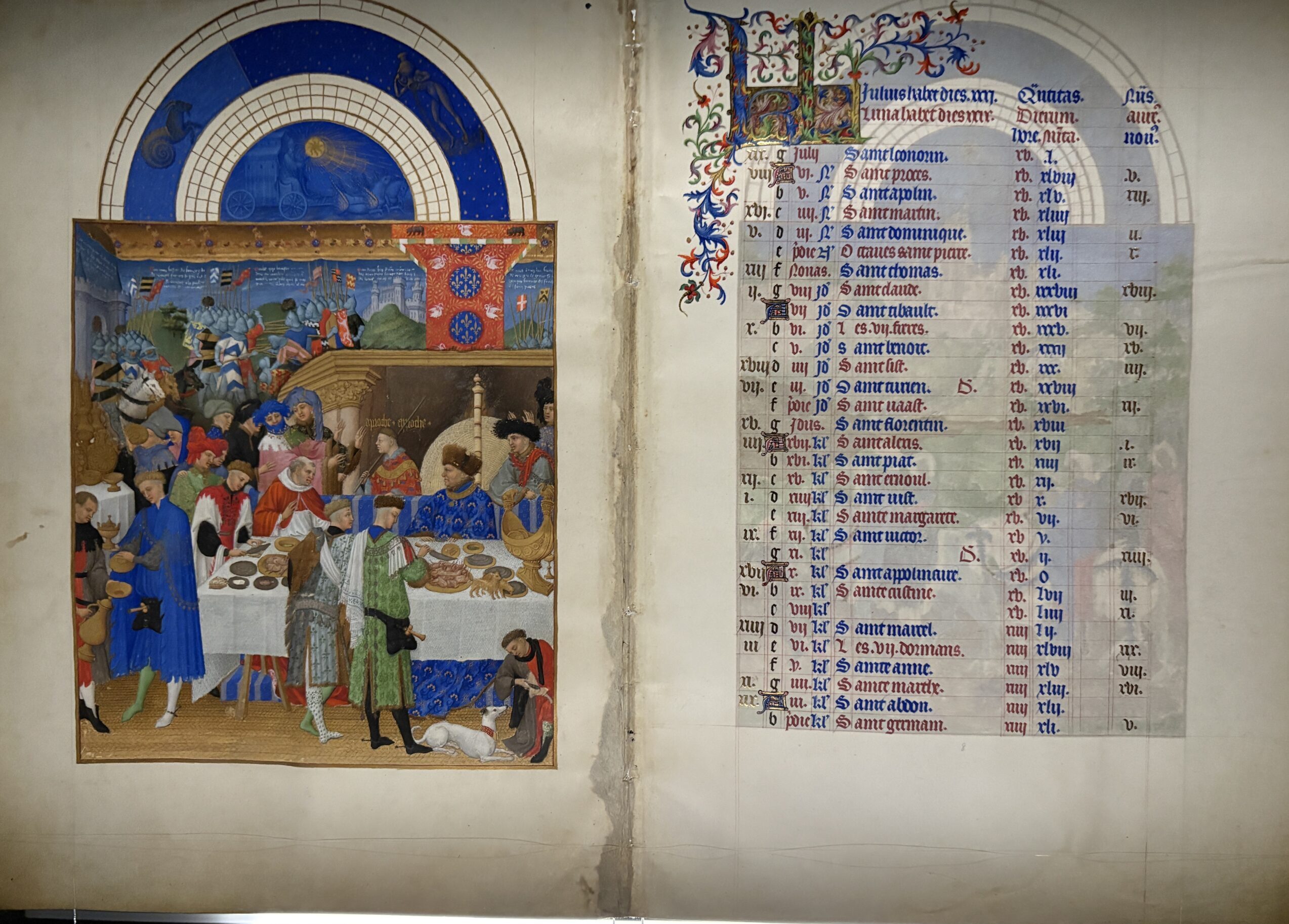
January Labour of the Month in the Tres Riches Heures of the Duc de BerryChristmas wasn’t really celebrated in historical times as a major festival, that was left to the New Year when gifts were exchanged, this was called the étrenne, and where the Duc de Berry was concerned, gifts were lavish and expensive. The Labour of the month for January in many Books of Hours was feasting and warming by the fire. There are some miniatures where people have taken their shoes off so that the heat from a fire is more effective.

January in the Tres Riches Heures of the Duc de Berry - table with foodJean, Duc of Berry, is no different, but it is on a different scale altogether! Here in this magnificent colourful image for January, Three men are serving meat at the Duc’s table laden with food, using large knives to do so.

It has been suggested that the two men with their backs to the viewer are pages as they have white linen napkins, one with his over his shoulder, and the other across his body. They may also be to hand to pass to the Duc de Berry when he has rinsed his hands removing the grease from the meat. One of them is wearing spurs, even indoors, indicating that he is ready at any moment to fight for his master.

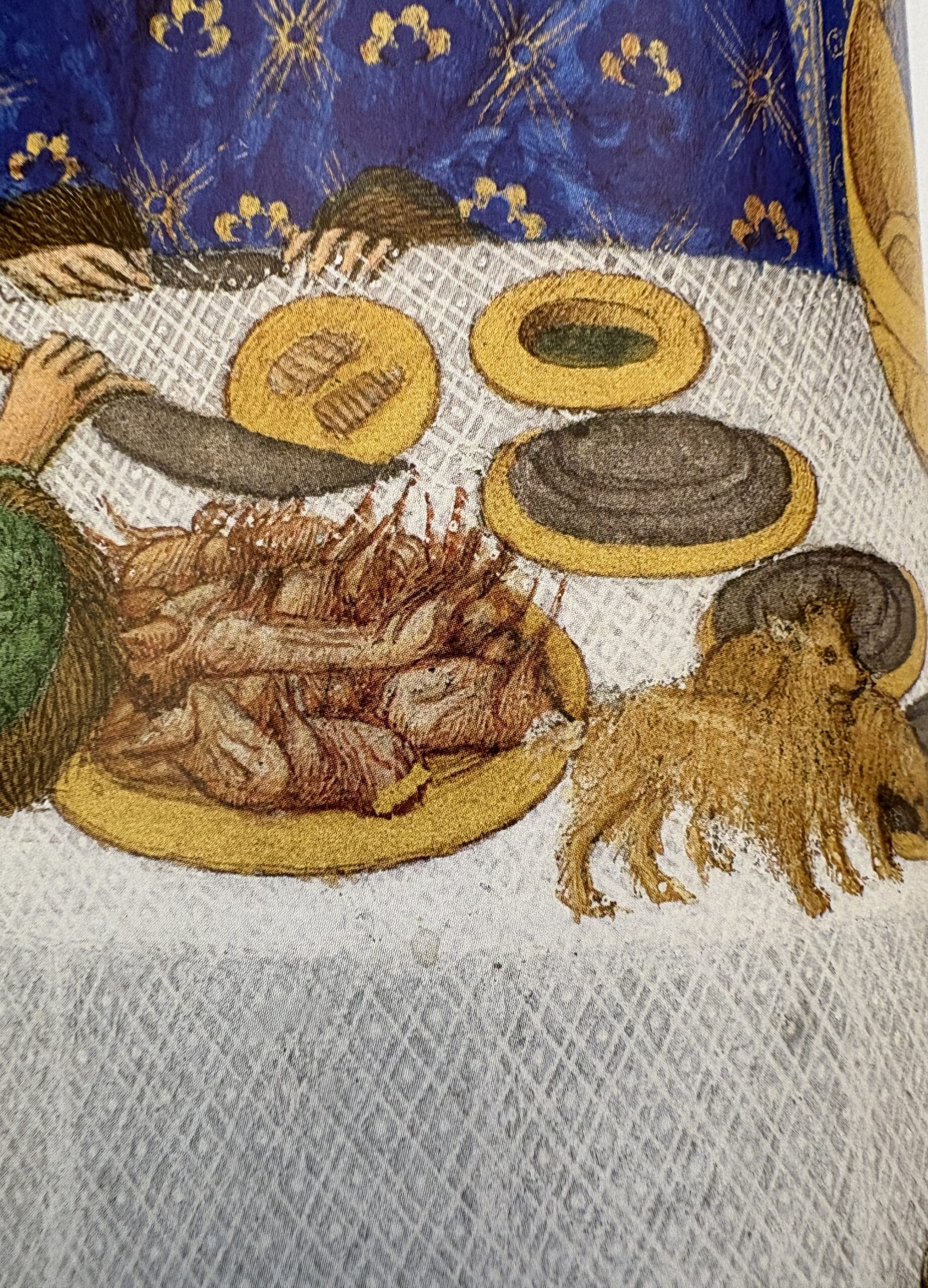
January in the Tres Riches Heures of the Duc de Berry large plate of meatThe Duc’s table, covered by a large white linen cloth, is laden with food including chickens and suckling pigs on a huge platter; they are carved by the green-tuniced figure almost in the centre of the image. Some of the carved meat is already on the Duc de Berry’s golden plate. Next to him is his finger bowl to rinse his greasy fingers, although they seem remarkably small as they rest on the table in front of him.


Two little lapdogs are standing on the table with their backs to the chickens and suckling pigs. Although they have their own golden plate, it is pretty unlikely, if my experience of dogs is anything to go by, that they would ignore this huge mound of meat!

The Duc’s white greyhound, meanwhile, is lying down on a rush-matting-covered floor waiting patiently for the kneeling man in sombre clothes enlivened with a red scarf to cut some pieces of meat for him.


January in the Tres Riches Heures of the Duc de Berry firescreen behind the DucThe other usual activity for January’s Labour of the Month is warming by the fire and it is no different in this image. Although he is wearing thick robes and a fur hat, the Duc is here sitting in front of a roaring fire protected by a woven circular firescreen supported by a central carved light wood pole. The flames from the fire can be seen above this. A rush (?) screen such so close as this to the Duc and the fire doesn’t seem that sensible with the sparks from the fire being thrown out!


January in the Tres Riches Heures of the Duc de Berry possibly a Van Limbourch BrotherOthers in this image are wearing fur hats and the two behind the Duc, both shown above and in the enlargement here, are thought to be two of the Van Lymborch Brothers. The one nearest to the Duc is leaning rather familiarly on the back of the Duc’s blue-covered bench. Both are wearing matching grey robes, with the one in front having a fur collar and a dark grey or black red tipped scarf, and the one behind warming his elegant fingers by the fire.

The detail on the woven firescreen can be seen better here, with the radiating ‘spokes’ and carefully woven weft, and the change of pattern nearer the edge.

January in the Tres Riches Heures of the Duc de Berry golden saly cellar in the shape of a boatThe 1st of January was also a time for gift giving, and it is possible that the magnificent golden salt cellar, to the right of the image, was one such. It is in the shape of a boat and at one end is a figure of a bear, the Duc’s symbol. Between 1401 and 1416 the Duc commissioned 119 objects, gave 231 gifts, and received 358 gifts from 136 different people – some gift giving, and the gifts were probably more than a pair of socks!!


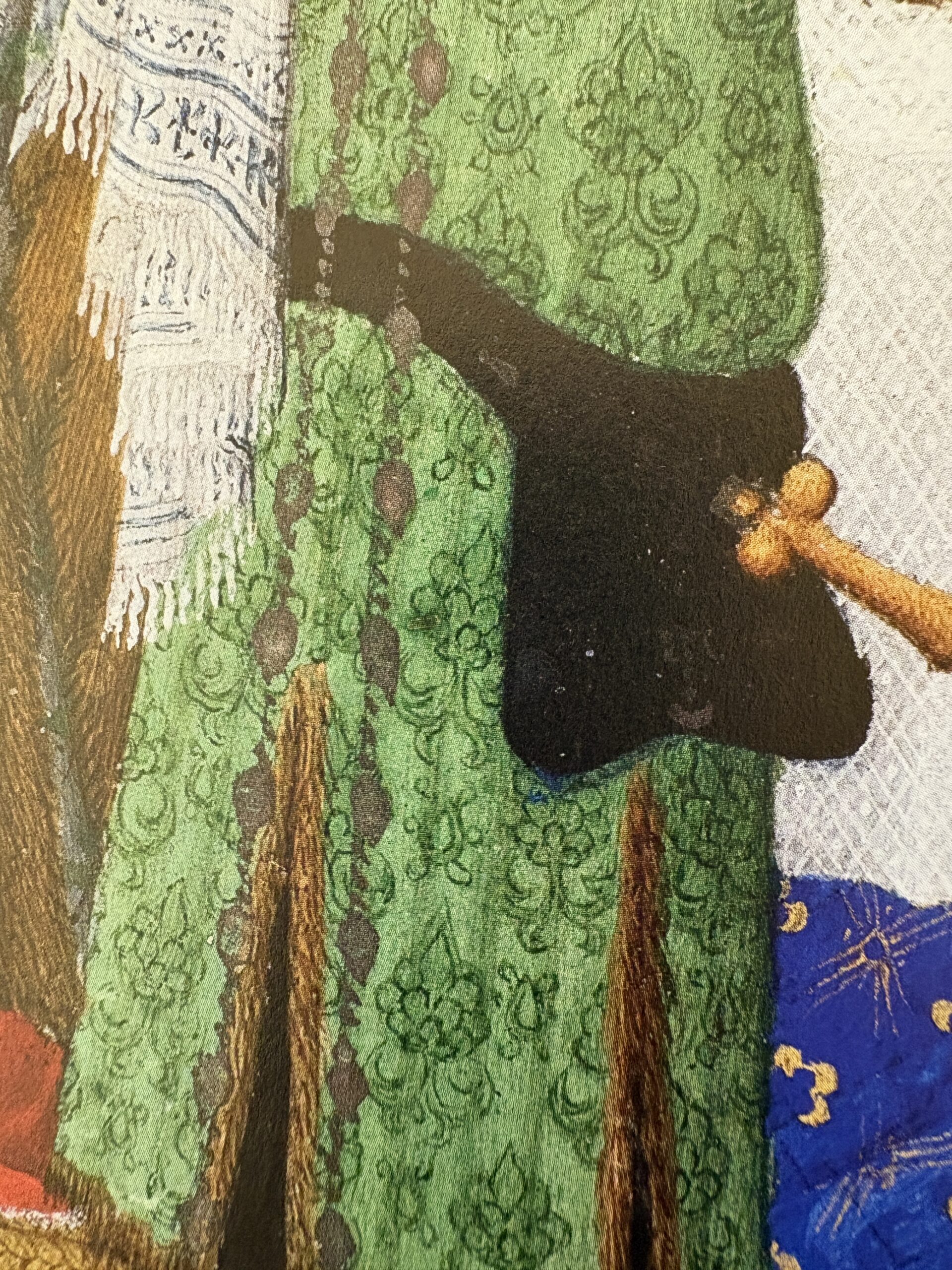
January in the Tres Riches Heures of the Duc de Berry enlargement to show textile detailIn this enlargement of the man almost in the centre of the image, the lavishness of the court dress and excellency of skill of the Van Lymborch Brothers is clearly seen. His tunic is lined with brown fur and the thickness of it can be seen in the way that it hangs and the slight bunching above his black belt – although, of course, this could also be due to the generosity of the Duc’s table! A delicate darker green pattern covers his tunic which is shown slashed in two places, and there is a gold chain dangling from an elaborate collar hanging right down to the hem. The grey-blue pattern, fringing and folds are clearly depicted on the linen napkin which is draped over his shoulder.

January in the Tres Riches Heures of the Duc de Berry enlargement to show textile detailSimilarly, the man next to him has a fur-lined tunic which is slashed but it is light and dark gray in vertical sections this time with a green leaf pattern overall. His wide, rather low slung belt is carefully painted and long tassels hang down from it. Just shown is his dark grey fur-lined cloak folded carefully over one shoulder.


January in the Tres Riches Heures of the Duc de Berry enlargement to show Zodiac detailSimilar to the other calendar pages in this Book of Hours, this page is topped by a deep blue, ultramarine, semi-circular depiction of the Zodiac at this time with Aquarius the water carrier following Capricorn. The sky is studded with shell gold stars, and, in the centre of the semi-circle, the sun in its winged chariot pulled by four horses relentlessly moves across the sky.

January in the Tres Riches Heures of the Duc de Berry to show feastingThe exceptional skill of the Van Lymborch Brothers results in this tour-de-force which must have delighted their patron, the Duc de Berry, when he opened this book.

Other calendar pages are here: and February NovemberJulyAugustSeptember, October and February

February in the Très Riches Heures of the Duc de Berry

December is the month for keeping warm indoors and for cutting wood for fires and taking it into the towns. This is shown for the Labour of the Month in the Très Riches Heures of the Duc de Berry. The scene on the left certainly looks very chilly!


To the right of the miniature a man is stamping his feet in the cold, and his head and upper body are covered with a blanket with his hands raised to his mouth, blowing on them to warm them up. The bee skeps to his right are covered in snow as is the wagon just in front of him.


Just above him the woodcutter is swinging his axe to chop down wood for the fires. It must be warm work as he has tucked his blue tunic into his waistband to show his white underpants. To his left a man and a donkey are taking the wood to the town. Note the snow covered hayrick.


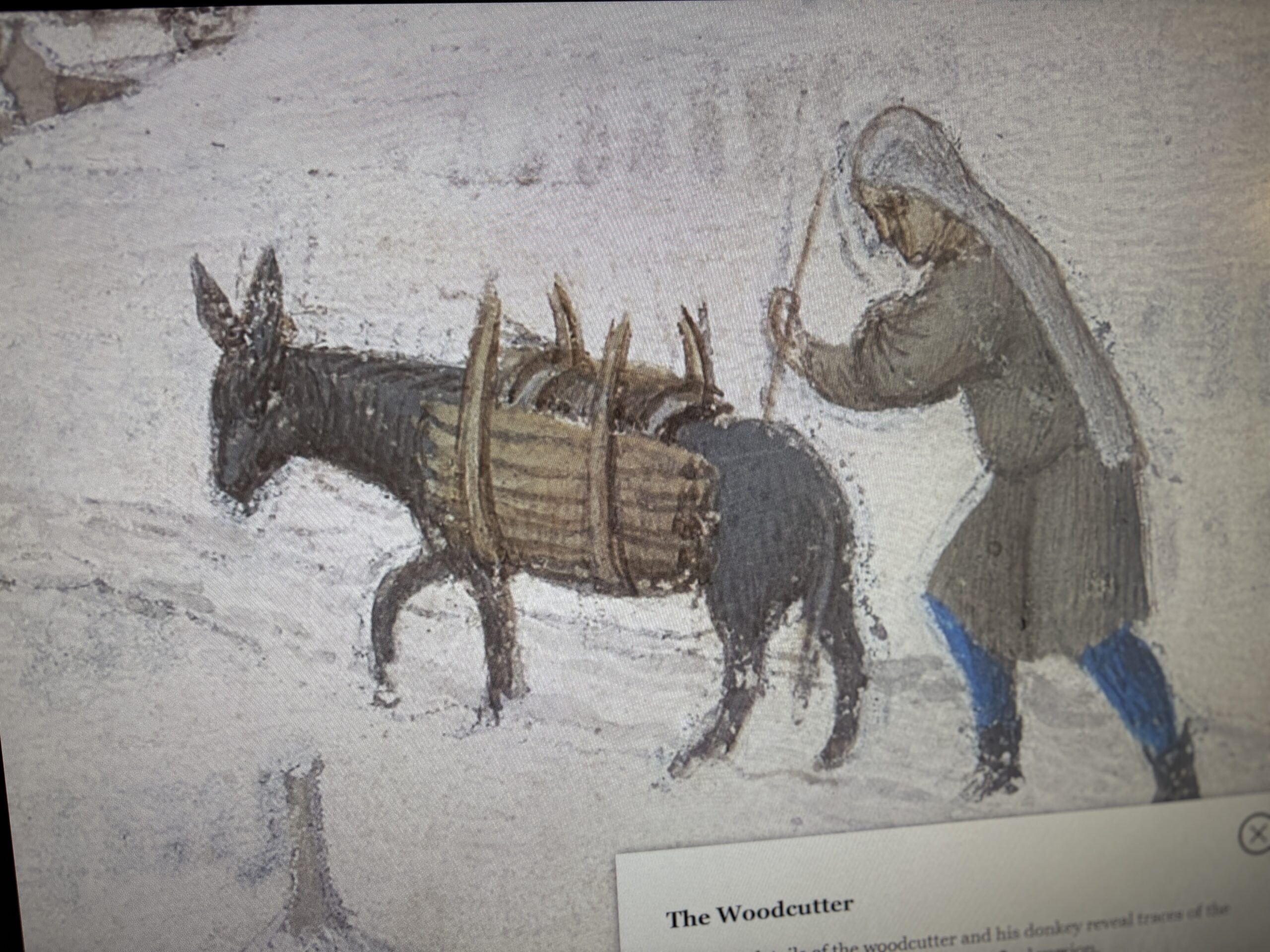
Interestingly, this image of the man and donkey shows sketched lines from the underdrawing and indicate the way in which the Van Lymborch Brothers altered the final painting from that planned as they worked. The donkey is loaded either side with neatly chopped logs.


Outside the mainly white sheep with a few black ones huddle together in a wattle-walled enclosure. The roof is thatched but there is a very obvious hole which would have let in the snow. Outside birds peck at seed left on the ground, and there are bound faggots of wood ready to be put on the fire.


The people who come off best in this image are the three lucky enough to be indoors and sitting in front of a blazing fire. It is painted as though the wall of the building has been removed so we can see the scene. A woman in a glorious blue robe with a black headdress has rather primly raised her dress to her calves revealing a white underskirt. Her companions, a man and a woman sitting on what looks like a blue padded settle, are not quite so delicate – their clothes have been raised to above their knees and it is clear that they have nothing on underneath!


As with all the Labours of the Month in this magnificent book, the scene is topped with a semicircular depiction of the heavens and the appropriate signs of the Zodiac. The sun in its winged charity is painted in shades of blue with a glorious gold sun, and wends its way in the centre of the semicircle; on the outer rim, also with a blue background are the signs of Aquarius, the water carrier, and Pisces, fish swimming in opposite directions tied together forever with a cord.

As with all the  miniatures in this glorious book, it is a tour-de-force. Anyone looking at the picture would feel the chill and extreme cold in this snow scene and the figures illustrate clearly the Labours for December from those working outside and being cold to those inside and enjoying the heat.

For other Labours of the Month from this  book click for November, JulyAugustSeptember, and October

August in The Très Riches Heures of the Duc de Berry

© Patricia Lovett MBE 2025

August is the month for hawking in the Très Riches Heures of the Duc de Berry, painted and illuminated by the Van Lymborch Brothers. A party of five, three women and two men, are mounted on three horses setting out to do just that. Two of the women are riding side saddle behind men, and the third woman, the most richly attired, is riding side saddle on the most sumptuously decorated horse. Behind them, very much in the background, are people swimming and others stacking the corn into sheaves ready to be carried on a cart by two oxen, one black and one brown.


© 2025 Patricia Lovett MBE

Ultramarine blue semi-circles top the main image with the appropriate signs of the Zodiac for August, Leo and Virgo, they are surrounded by a sprinkling of stars. In the innermost section of the semi circle is the relentless sun charting its way across the sky in a chariot. Semi-circles of shell gold, polished to a brilliant shine, also adorn the image. It is clear that all the semi-circles were constructed with compasses.


© 2025 Patricia Lovett MBE

The castle in the background is the Château d’Étampes, near Paris. The Van Lymborch Brothers included a number of the Duc de Berry’s castles and châteaux in their paintings and this one looks particularly splendid with its high main square tower, five smaller towers, three of them with turrets, and a high encircling wall.


© 2025 Patricia Lovett MBE

In the river below the castle, the Van Lymborch Brothers have shown people enjoying themselves swimming and splashing around in the water.


© 2025 Patricia Lovett MBE

A man in a white long-sleeved shirt has an over tunic of grey with the skirt slashed high on his thighs. He is wearing a straw hat and a thick glove to protect his hand from the two hawks sitting on his arm. His very long pole drags behind him on the ground and he is stylishly wearing one long red sock and one black one. It’s clearly hot as he has no leg covering above the knee.


© 2025 Patricia Lovett MBE

The most richly dressed woman has a cloak of glorious ultramarine lined with white fur (in this weather?) which drapes low over her and the body of white horse. The cloak has a circlet of gold decorated with circles and two long braids of gold which are attached to the cloak but extend way beyond it and the horse. These are painted in shell gold and the fine detail is amazing with such a tricky medium. The bridle, headband and straps on the horse are also in the most expensive pigment of ultramarine and again with shell gold painted patterns. The saddle cloth is in cinnabar (vermilion) also a very expensive pigment, and again with shell gold decoration.


© 2025 Patricia Lovett MBE

© 2025 Patricia Lovett MBE

Enlargements of the decorations show the fine detail of the decorations and the white fur peeping out from the slashed hem and cuff of the cloak:


© 2025 Patricia Lovett MBE

One of the other women is wearing a black dress with red sleeves, and what looks like gold kid gloves. Her contrived linen headpiece will at least keep her face shaded from the sun but it must have been a bit tricky to wear and keep on! She is behind a man in a pale blue cloak decorated with a silver pattern and a shirt with a wide white lace collar. He is wearing a stylish straw hat.

It is difficult to show in these images how small the pages of the book are and thus the paintings. The Van Lymborch Brothers were incredibly skilled working with such fine detail as such a small scale.


The Duc de Berry and the Très Riches Heures

Duc de Berry diningThe Duc de Berry really must have been someone to know in the fifteenth century, with his lands, castles, and an unerring eye for quality, craftsmanship and fabulous objects. He described himself as the son, brother and uncle of a king, and lived to the ripe old age of 76.

The Très Riches Heures of the Duc de Berry is a case in point as regards his recognition for exquisite skill and his support for artisans. He is painted here in the manuscript by the artists Herman, Paul and Johan – the Van Lymborch Brothers (previously Limbourg). Note the Duc’s well-dressed servants waiting at his table with one of them just about to carve chickens, his steward holds his stick of office and is calling people forward, and on the Duc’s table is a salt cellar in the form of a magnificent gold galleon with a gold bear at one end – one of the Duc’s symbols.

This close up of the Duc shows him wearing a thick fur hat with each hair painted individually and precisely, his plush deep ultramarine blue brocade robe has gold embroidery and decoration. It is lined with fur, very luxurious and it looks very thick and heavy; the fur also peeps out at his neck and forms cuffs on each wrist. He does, though, have surprisingly small hands. The Duc wears a thick gold collar from which hangs a medallion, and his two little lap dogs are on the table enjoying food from one of the gold plates.


The effigy on the Duc de Berry’s tomb shows a remarkable resemblance to his portrait in the Très Riches Heures with his downturned mouth and double chin. He is wearing here an elaborate headdress of what looks like a circlet of pearls or small silver balls, and large square cut and rounded gems all neatly held in place with clasps.


It is easier to see his coronet in this photograph. They are very large stones!


The Duc is wearing robes of regal ermine, with the black tips of the tails pushed through slits in the white fur and represented here by black curving shapes. At first it looks as if these were painted on the marble but in fact each one of black stone has been inset to the white marble with the greatest precision.


The Duc was very fond, and proud, of his castles and homes, and the Van Lymborch Brothers were very clever and inventive in incorporating them into their paintings in the manuscript. Here is a map of his châteaux and palaces linked to the various paintings in the miniatures.


It is difficult to appreciate the small size of many of the paintings by the Van Lymborch Brothers. This of the Zodiac Man is about the size of a quarto sheet of paper, and the detail is incredible.


Different parts of the body relate to the various Zodiac signs. This enlargement shows the partial bull of Taurus behind his neck, Cancer at the throat, Leo on his chest, and one of the Gemini twins peeping out from behind his arm. The head and blue robe of Virgo is just visible.


In some of the miniatures in the Très Riches Heures treasures belonging to the Duc de Berry are depicted such as this magnificent bejewelled gold cross, studded with exquisite pearls, rubies and sapphires.


And here is a very similar one painted in the Heures:


The stand out stars of the manuscript for many are the calendar pages, each double spread showing a full page miniature of the labours of the month, and on the opposite page the important religious festivals and saints’ day so they could be celebrated by the owner of the book in their own home, One after another they form a visual feast! Books of Hours being produced for lay people. Here is the one for April, the month for weddings, and indeed one is depicted here. In the semicircle at the top the ram of Aries is followed by the bull of Taurus.

There will be more posts on this book in due course. Meanwhile, here is the one for the calendar month of July.

July from the Très Riches Heures of the Duc de Berry

The Très Riches Heures of the Duc de Berry is an absolutely masterpiece. Created by the Van Lymborch Brothers (previously Limbourg), Herman, Paul and Johan, they consist of page after page of the most magnificent and exquisite paintings. This post focuses on the calendar page for July; there are other blogposts on this website.

Photographs here are all my own, (© 2025 Patricia Lovett) and taken at the exhibition of the Très Riches Heures of the Duc de Berry at the Château of Chantilly in the summer of 2025.

July is the month for harvesting wheat and shearing sheep. Two men towards the lower half of the miniature are cutting wheat with sickles, and, as they do, the blue and red flowers are being revealed. At the bottom right a woman in a blue dress and a man are shearing sheep. This particular painting is interesting because the angles of the château in the upper part of the image are reflected in the diagonal stream and the edges of the field. The mountains left and right at the top echo the shapes and draw the eye down and into the page.


The detail in the sheep shearing scene can be seen in this enlargement. Both shearers are using large shears which are operated not from handles through which thumb and fingers go, but by pressing on the blades themselves held open by a circular spring. The wool coming off the sheep being sheared by the man is shown falling on to the ground where it is in a large pile. He is wearing a fashionable bucket hat with a piece of pink fabric hanging down to protect his neck from the sun, but his clothes are rather worn and ragged, the sleeves are frayed and the knees of his breeches are worn away. The woman has a glorious deep blue dress which looks in better repair, and a black hood again for protection from the sun. Relieved of their thick wool coats, the sheep are grazing peacefully.

The other workers in this miniature are the reapers the other side of a small reed-lined stream. One of them has succumbed to the heat and is wearing just a white shirt and underwear; his partner’s tunic is split up to his thigh. Both are wearing straw hats to protect them from the bright sun.

The Duc de Berry was very fond of his castles, palaces and châteaux, and the Van Lymborch Brothers often incorporated them in miniatures in his books. This is a depiction of the Château de Poitiers, an unusual triangular- shaped building with a raised wooden walkway on stone supports providing the entranceway over the moat.

This is shown in greater detail in this enlargement. It is not quite of a high enough resolution to make out the precise strokes used by the brothers to show the curve of the tower and turrets, the covered wooden walkway, and the steeply gabled windows in the roof.


At the top of each calendar miniature are Zodiac signs for that month, here Cancer the crab followed by Leo the lion are set in a dark blue sky with golden stars. The sun, stars and semi-circular lines and divisions are in shell gold which is applied with great precision. There will be other posts on the calendar months on this website.

Here is more on the Très Riches Heures and the Duc de Berry.