Tag Archives: Labours of the month

April in the Très Riches Heures of the Duc de Berry

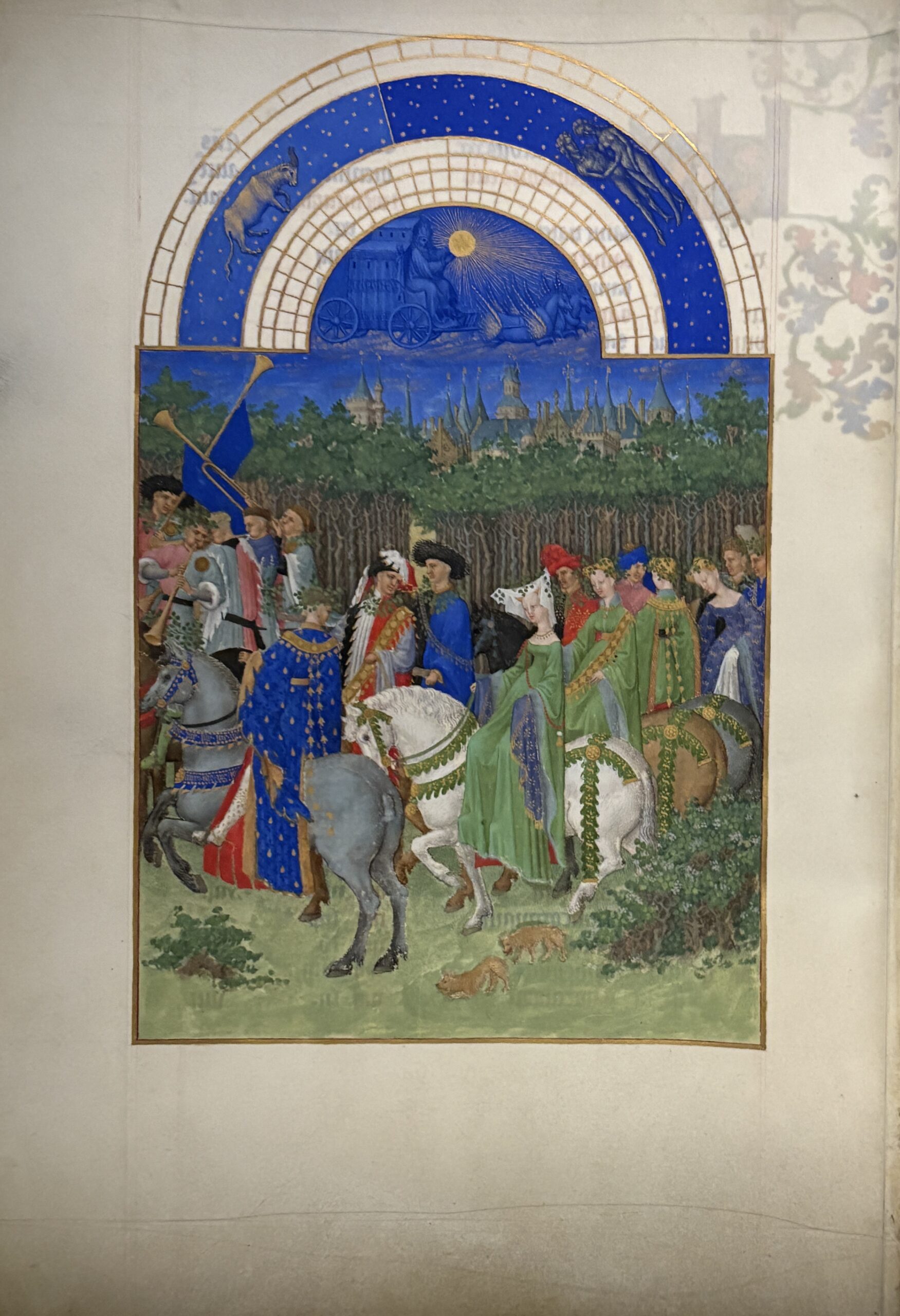
April in the in the Très Riches Heures of the Duc de Berry April is the month for engagements in the Trés Riches Heures of the Duc de Berry, and shown here is a very elegant group dressed in rich fabrics with the happy couple giving and taking the engagement ring. The striking blue of the cloak of the man on the left, the woman sitting, that of the sky, and the semicircles above completely balances in the painting.


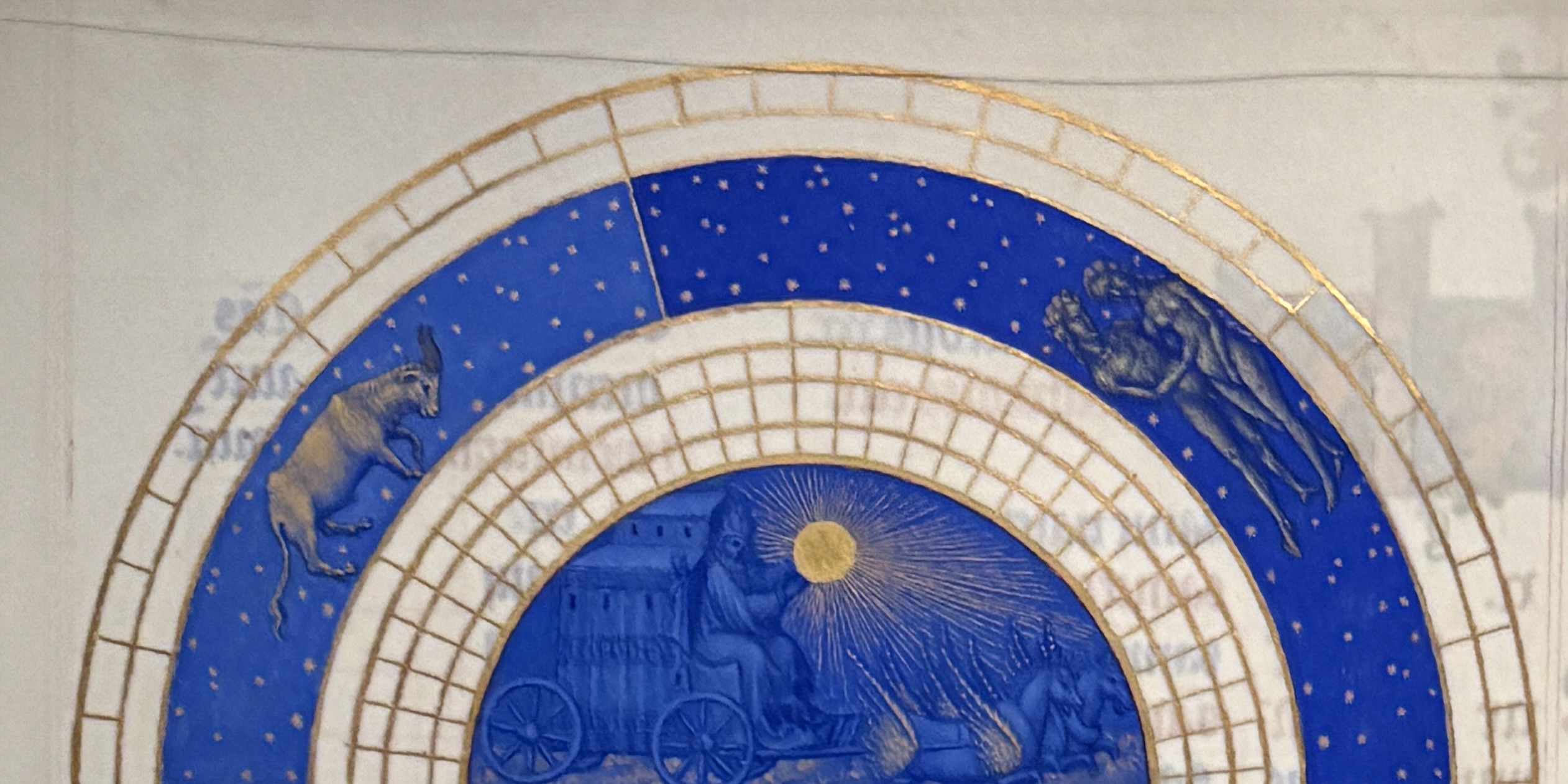
April heavens in the Très Riches Heures of the Duc de BerryAt the top of the image, as with all of these Labours of the Month in the Très Riches Heures, is a semicircle with repeated fine shell gold lines encasing two wide blue borders. The sun in its winged chariot and pulled by horses – picked out by shades of blue and highlights of gold – are in the inner one, and in the outer one are the astrological signs for the month – Aries the Ram and Taurus the Bull.

April in the Très Riches Heures of the Duc de Berry castleOn many such pages the Van Lymborch Brothers include one of the Duc de Berry’s castles and houses, and that is the case here. This time it’s the Château de Dourdan with it’s fine red tiled roof, high walls, and many conical towers.

Men fishingBelow the castle are the tiniest of boats, two of them, each containing a man rowing. Between them the floats for a net attached to each of the boats are shown by tiny dots, and to the left is what looks like a weir.


Walled gardenCarefully and exquisitely painted is the edge of a stone building with four diamond leaded light windows, and a walled garden with well-kept beds and fruit trees in blossom – appropriate for the month. Some plants are being trained up the back wall – espaliers – and there is a trellis separating parts of the garden.


But the main focus is the engagement with the four main figures in the foreground. Their clothes are rich and colourful, the ultramarine blue of the man on the right offering the engagement ring is particularly striking, especially in contrast to his gloriously plumed red hat! His bride-to-be looks suitably modest as she accepts the ring; she’s wearing a paler blue gown decorated with a regular deeper blue pattern, which so cleverly changes according to the folds lower down as she hitches up the skirt. Behind them are probably her parents, her mother in a rather sombre black dress but with bright red sleeves for contrast, looks as if she is encouraging her daughter to accept, and her father on the left, in a subdued grey gown with gold trim, is supporting his wife. His gown may be sombre but note that extravagant black hat and those red stockings!!

Two women one in a pretty pink dress clinched at the waist with a gold belt, her flaxen hair loose and falling in waves to her waist, wears a circlet of gold roses, on her head, and her companion, with a rather strangely shaped ultramarine blue hat decorated with pearls and a gold medallion, has a deep blue dress and a black and white over-tunic. It looks as if they may be picking flowers perhaps to create bouquets on such an auspicious day.

Yet again the Van Lymborch brothers have created a wonderfully joyful page, full of details and painted exquisitely.

For more Labours of the Month click on these links:  JulyAugustSeptemberOctoberNovemberJanuary, February and https://www.patricialovett.com/march-in-the-tres-riches-heures-of-the-duc-de-berry/


December in the Très Riches Heures of the Duc de Berry

The ‘Labour’ of the Month for December in the Très Riches Heures of the Duc de Berry is boar hunting as evidenced by this rather gory image of a dead boar lying in its own blood having been hunted by dogs. It is hardly a labour apart from for the huntsmen involved! Three men are really struggling to control the dogs even though the boar is clearly dead.


The huntsman on the right in the miniature is blowing a horn, which is attached to his body by thick leather straps going over his right shoulder; he is supporting the horn in his right hand which is awkwardly twisted round (it would be more natural if it was held with his hand the other way round so that his thumb is the most visible with the tips of his fingers indicating the grip). In his other hand he holds a long spear. The white highlights really do stand out on the horn, and also the single dot as the white of his eye. He is wearing a fur hat, a glorious blue tunic which looks thick and warm and which is pulled in by a black belt, and he also wears a black undershirt with black boots.


December in the Tres Riches Heures of the Duc de Berry - huntsman in red tunic holding back a hunting dogOpposite him is a burly fellow with tousled hair and a bushy beard endeavouring to pull a brown dog which is wearing a heavy thick collar away from the boar. He is grabbing it by the ears, and the dog’s expression clearly shows that it is not enjoying the restraint! On the right of this huntsman’s red tunic are straps to leash the dogs. The dog’s teeth and the spittle from its mouth show how fierce these dogs are!


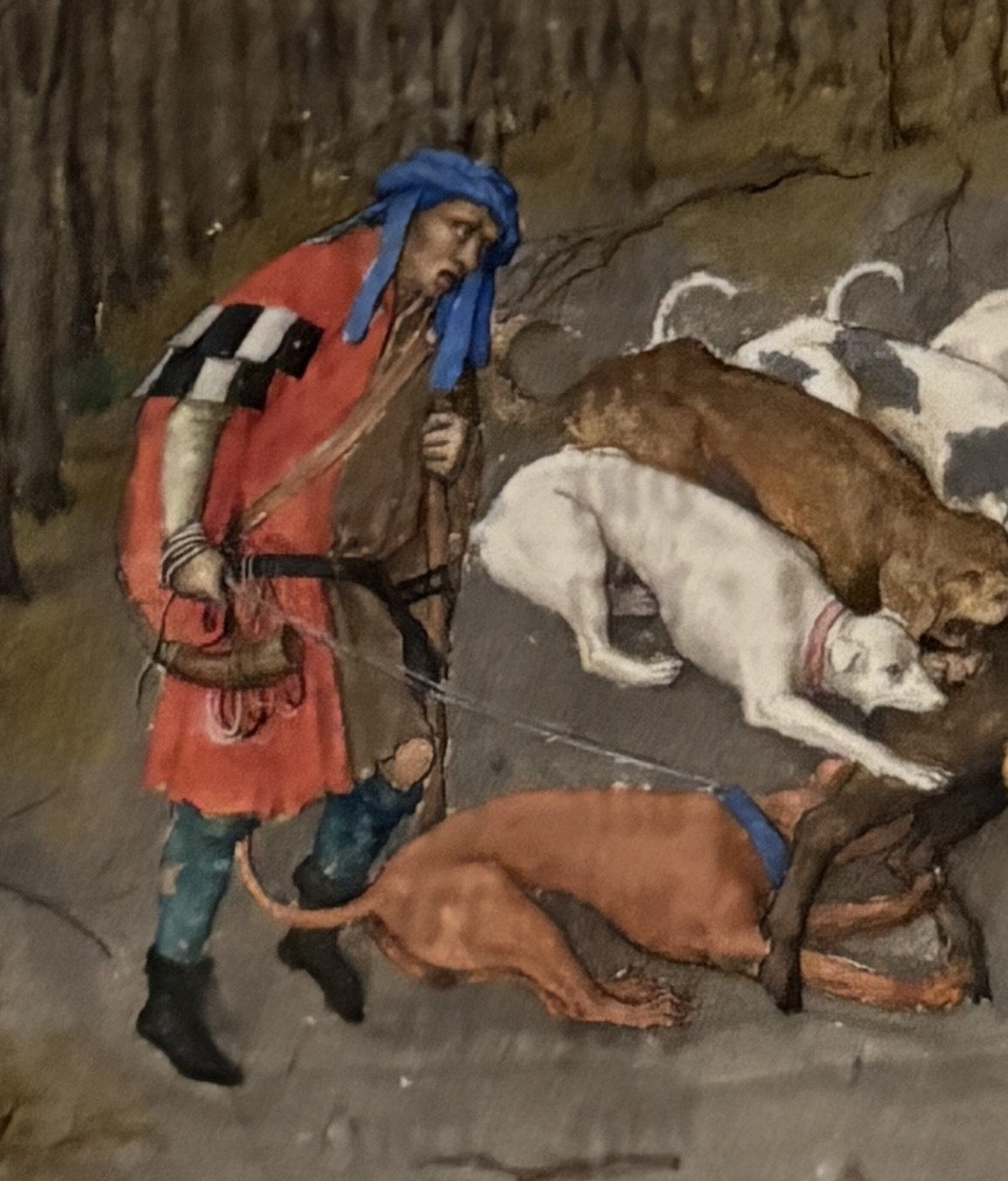
December in the Tres Riches Heures of the Duc de Berry - huntsman in red tunic holding a fierce dogThe third figure in this image is another huntsman looking rather disgruntled. He is wearing a blue hat with strips hanging over his shoulders, and his tunic is red and brown with a black and white check band over his shoulder; this tunic is held in with a black belt from which are hanging both his hunting horn and leashes for the dogs. He is holding on to a lead which is wound round his wrist and attached by a blue collar to a large brown dog clearly resisting being pulled away, as can be seen by the acute angle of its back legs and the way in which its collar is being pulled from its neck. Despite his two-coloured tunic his socks with large holes are falling down and his expression is one where he looks as if he wants to get back in the warm!

December in the Tres Riches Heures of the Duc de Berry - hunting dogs attacking a boarThe dogs look so vicious and I pity the poor boar who mustn’t have had much of a chance with this pack! They are beautifully painted, though, and the way in which they are pulling at the boar is depicted so well – there is a real tension there.


December in the Tres Riches Heures of the Duc de Berry - Chateau de VincennesAs with many of the images in this manuscripts, one of the Duc de berry’s castles is shown in the distance. This time it’s the Château de Vincennes, its towers stand proud over the canopy of winter trees.


December in the Tres Riches Heures of the Duc de Berry - semi circle of depiction of the heavens at this monthEach month has a semi-circle of the heavens and astrological signs heading the main image, and December is no different. Sagittarius gives way to Capricorn and the sun chariot, drawn by four horses, relentlessly moves across the sky in the centre.

December in the Tres Riches Heures of the Duc de Berry - single pageYet again the incredible and inventive designs of the Van Lymborch Brothers are evident in this richly painted miniature.


For other months please click here for July, August, September, October, November, January, February

November in the Très Riches Heures of the Duc de Berry

Pannage or ‘common of mast’ is an ancient traditional of letting pigs run in woodlands and forests to eat acorns and nuts. It’s shown here in the Labour of the Month for November painted in exquisite detail by the three Van Lymborch Brothers for the Très Riches Heures of the Duc de Berry. Pigs are busy eating acorns in the foreground with others in the woods.


Each page for the Labours of the Month is topped with a semi-circle of the Zodiac symbols associated with the time of year, here Scorpio can be seen on the left and Sagittarius on the right, both are in shadow within the glorious ultramarine background. In the middle of the semi-circle the relentless movement of the sun in a chariot is drawn by four winged horses.

On the left of the image a man wearing a pink tunic and a black scull cap holds in his hand what looks like a whip. This is possibly to knock more acorns from the trees, although if it is a whip, it doesn’t look long enough to be effective on the tall trees on the right. He has grey socks pulled up to his knees and it looks like garters are tied round at the top to keep them up. His dog looks totally fed up sitting beside him!


The pigs are shown in great detail, busily eating the acorns on the ground, and even the acorns, at this tiny detail, are clearly depicted. When magnified each ‘nut’ is sitting in a cup and there is even a highlight of white on each one.


It is quite amazing how much detail the Van Lymborch Brothers have put into the pigs. The body has been painted in various shades of brown to give shape, and then white and brown bristles have been added individually with short strokes of the brush; there are more white bristles where there needs to be highlights as here on the face of the middle pig.


Even the curly tails have been painted as this pig, backside in the air, buries his face in bushes to get at the acorns.


In a similar way, the leaves on the trees give great depth to the woodland with even individual leaves in various shades of green being indicated.


This page is yet another tour-de-force from the Van Lymborch Brothers who have most admirable skills in being able to change 3D into 2D.

For other Labours of the Month from this book click for July, August, September, and October.


October in the Très Riches Heures of the Duc de Berry

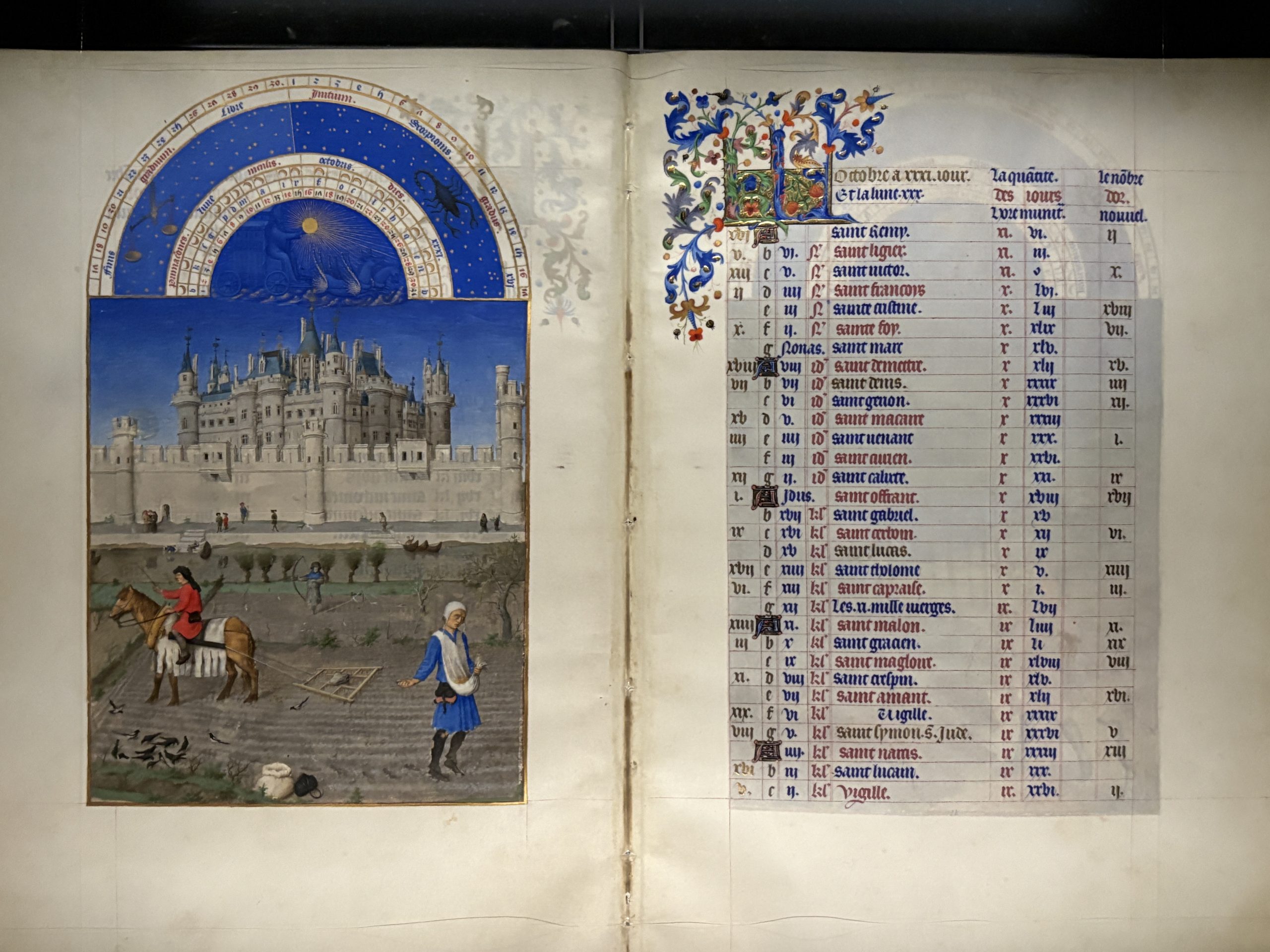
The Très Riches Heures of the Duc de Berry are lavish in the extreme, written in a precise and regular Gothic Textura, accompanied by exquisite paintings by the three Van Lymborch Brothers. There’s more on the Duc de Berry in a previous blogpost here. Each month of the year shows a calendar of saints’ days, feast and holy days, with a Labour of the Month opposite. October is the month for preparing the soil, breaking it down to fine tilth by harrowing, and sowing seeds before winter sets in.

Atop each calendar page is a semi-circular painting of the sky at that time of year with the star sign of Libra giving way to that of Scorpio. In the inner part of the hemisphere is the relentless passage of the sun, drawn by in this case wingèd horses rather than a wingèd chariot. The subtleties in shades of ultramarine blue to depict this scene really are incredible.

In many of the Van Lymborch paintings the palaces, castles and châteaux of the Duc de Berry are included, and this calendar page is no exception; this time it’s the Palais de Louvre in Paris. This is a magnificent building having a high surrounding wall with round towers, boxy projections over the wall, and battlements with arrow slits. The palace itself inside the wall is huge, as would be expected, with again round towers and battlements, cone-shaped roofs and many chimneys.

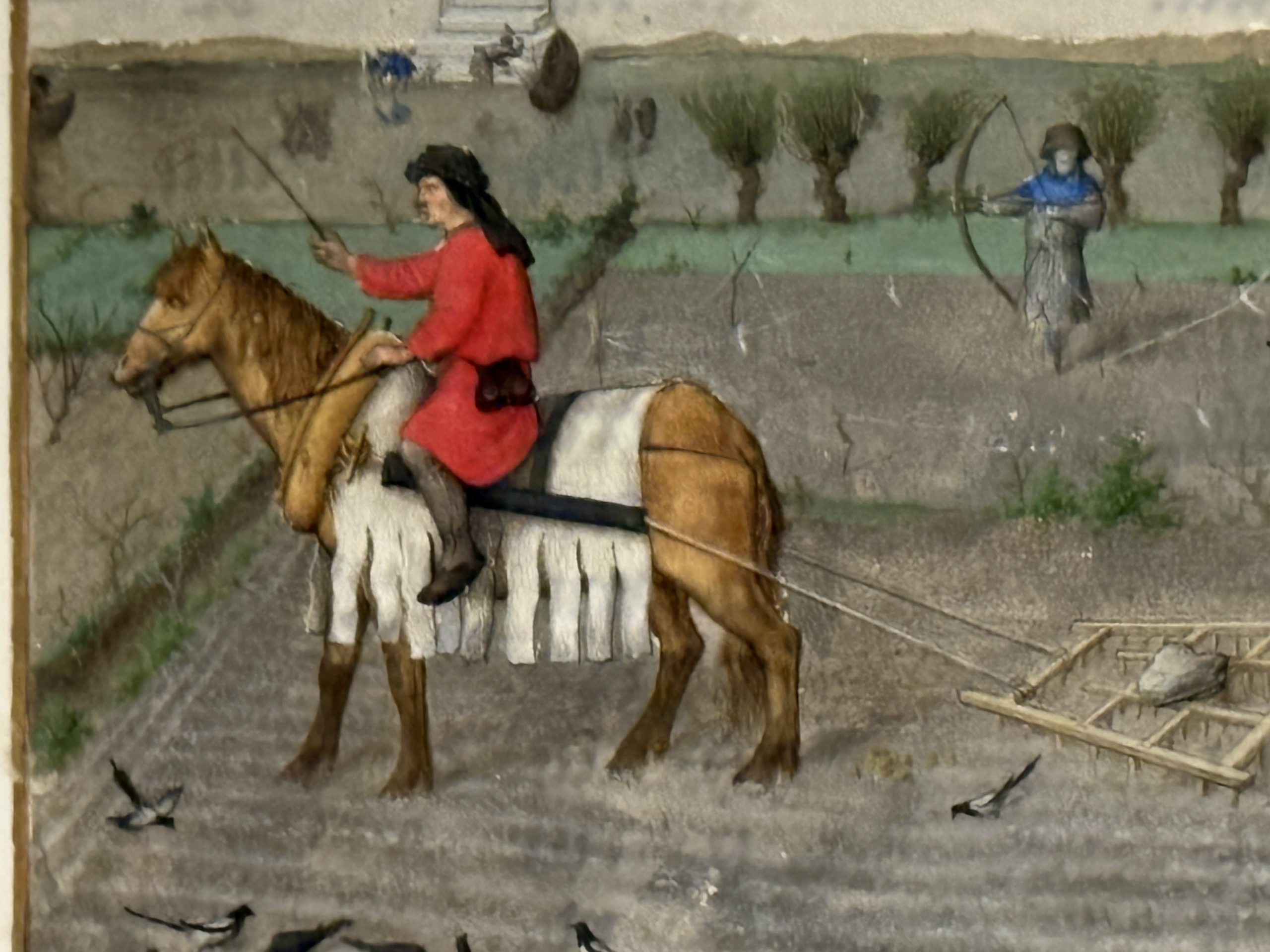
In the foreground a man with a black head covering, dressed in what looks like an expensive red tunic with a black pouch attached to a belt around his waist, rides a horse with a rather impractical white saddle cloth – in fact the whole ensemble looks more appropriate for a courtier than a man working the soil. The horse is pulling a harrow, a wooden frame with spikes underneath, to break up the lumps in the soil, remove weeds and create a suitable seedbed. Note the scarecrow behind holding a bow and arrow. It doesn’t seem to be that effective with all the birds around. There are even white strings stretched out over that far bed to try to keep birds off the seeds.

The painting of the harrow is particularly detailed with the struts of the wooden frame and the spikes going in to the ground clear even at this tiny scale. A heavy stone balanced on the harrow ensures that it doesn’t just bounce along on the surface. Magpies and crows are nearby ready to peck at any worms disturbed by the process, and the Van Lymborch Brothers in their usual ‘earthy’ way even include yellow horse droppings in this painting. Note the number of tiny brush strokes with various colours of brown and some white which give such a good effect in depicting the soil.


The man sowing the seeds also wears a brightly coloured tunic, this time in blue, with his pouch at his waist just below the white ‘apron’ arrangement which holds the seeds being scattered by his right hand. The pouch itself is intriguing; it looks as if it is expandable with a ‘concertina’ of pink leather or fabric between the two black covers, the visible top one being decorated. Two straps, one with a buckle, hang down from the wider side of the pouch and would be used to close it when there is less inside. His expression is not a happy one, and this may be because he is cold – look at the holes in his stockings and the way in which they are frayed at the bottom – or he may just be fed up that the seed he’s sowing is being eaten so quickly by the birds. The detail in such a small figure is simply amazing!

Yet again the Van Lymborch Brothers have excelled themselves in terms of exquisite and supreme craftsmanship, attention to detail and recording farming activities for the month.

There are other blogposts on the months in the Très Riches Heures: July here, August here, and September here.