
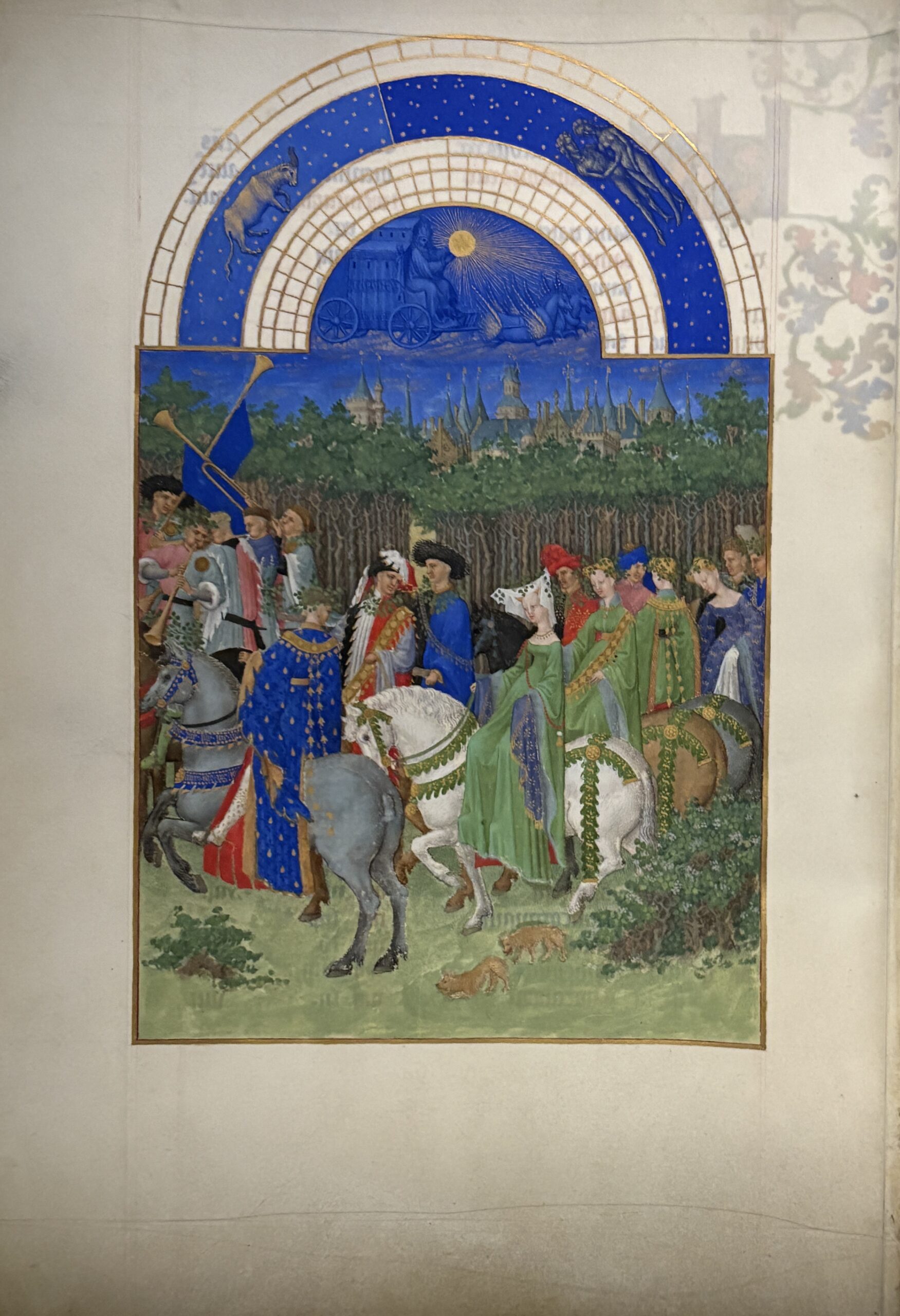
 The usual Labour of the Month for May is hawking, but it can also be courtly love. Neither is obvious in the illustration for May in the Très Riches Heures of the Duc de Berry by the Van Lymborch Brothers – no birds, and no obvious hands being held, or loving and longing glances being exchanged, but there are certainly beautifully well dressed young men and women on horses forming a procession and ‘bringing in the may’. May 1st was a special day in France and celebrated at the French Court; this image certainly emphasises that.
 The procession is preceded by trumpeters and buglers announcing the richly dressed men and women behind them. The musicians are all blowing lustily and some of their brass instruments are bedecked with ultramarine blue flags. They are wearing garlands of green leaves to commemorate the special day.
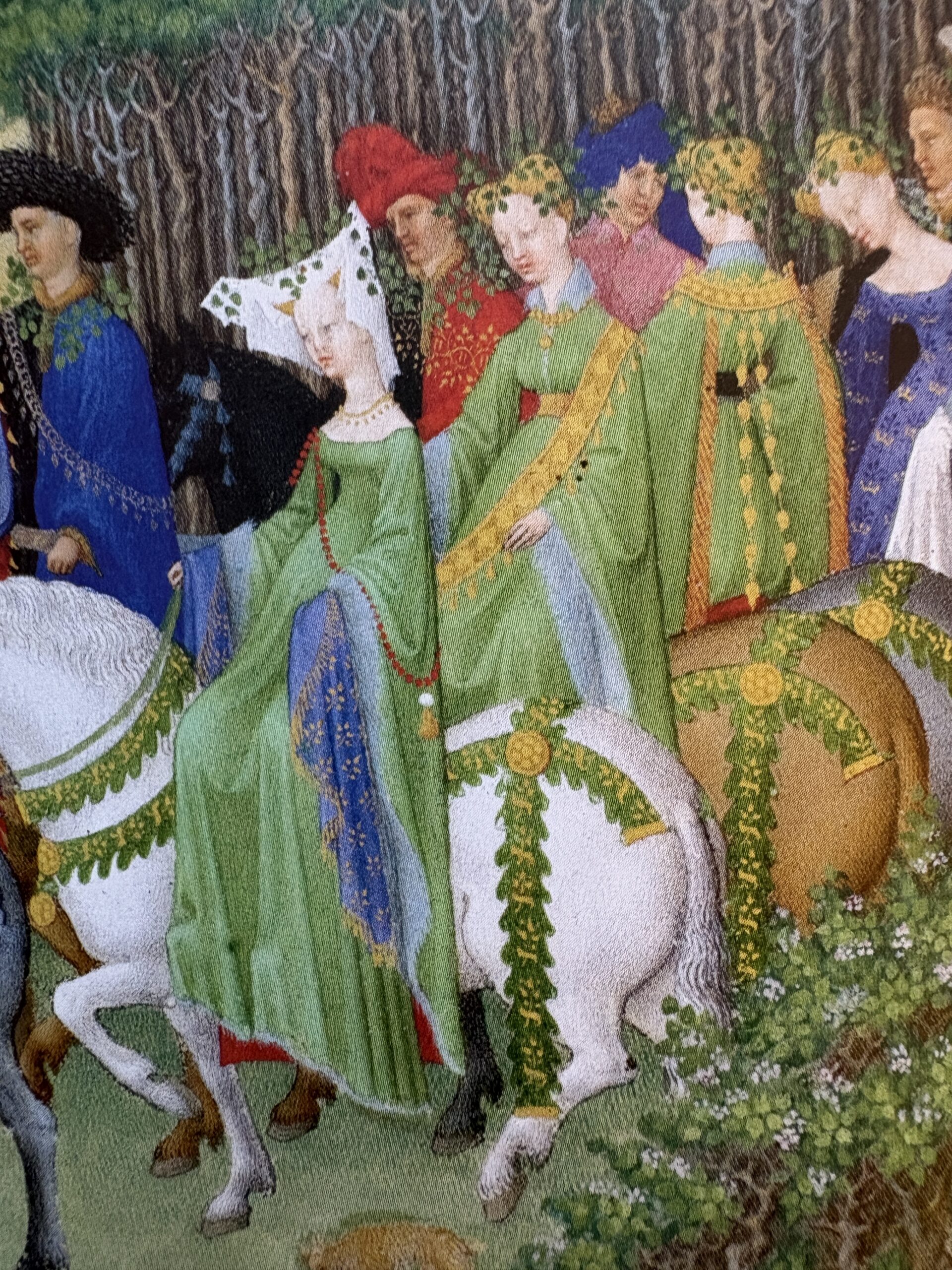 The women wear robes of bright green, the colour of spring and of fairies. It’s also the shade of green called ‘vert gai’ which Charles VI liked to give to his favourites at this time of year. Their hair, and the white headdress of the woman riding a white house at the front are decorated with garlands of green leaves which they may well have picked from the forest they have just left.
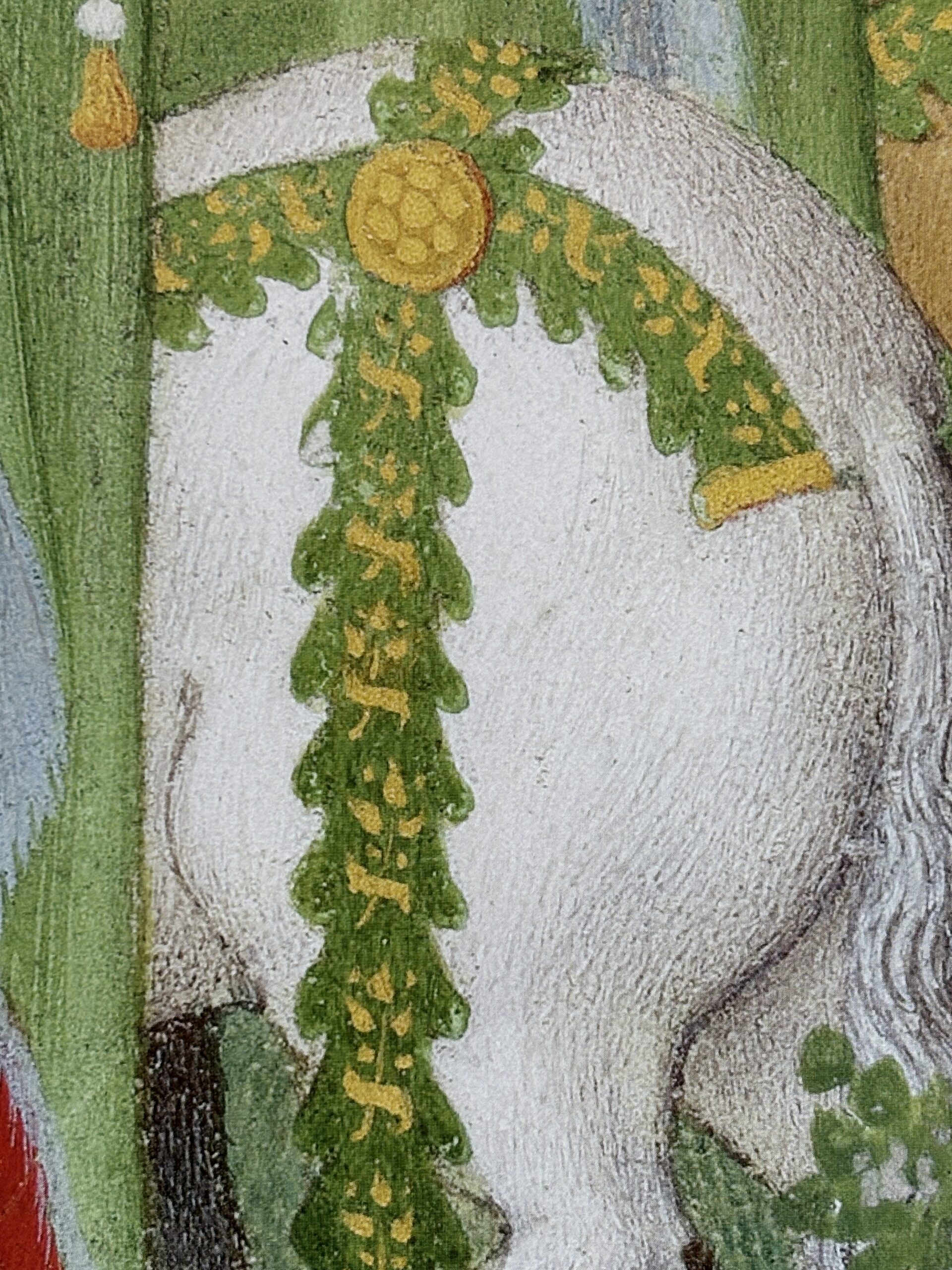 The painting of that white horse is exquisite with tiny brush strokes of a darker grey used to outline and to create the form and shadows of the animal. The green and gold horse trappings are also meticulously painted, even to the extent that they actually work – a narrow band passing under the horse’s tail which anchors the strap into place.
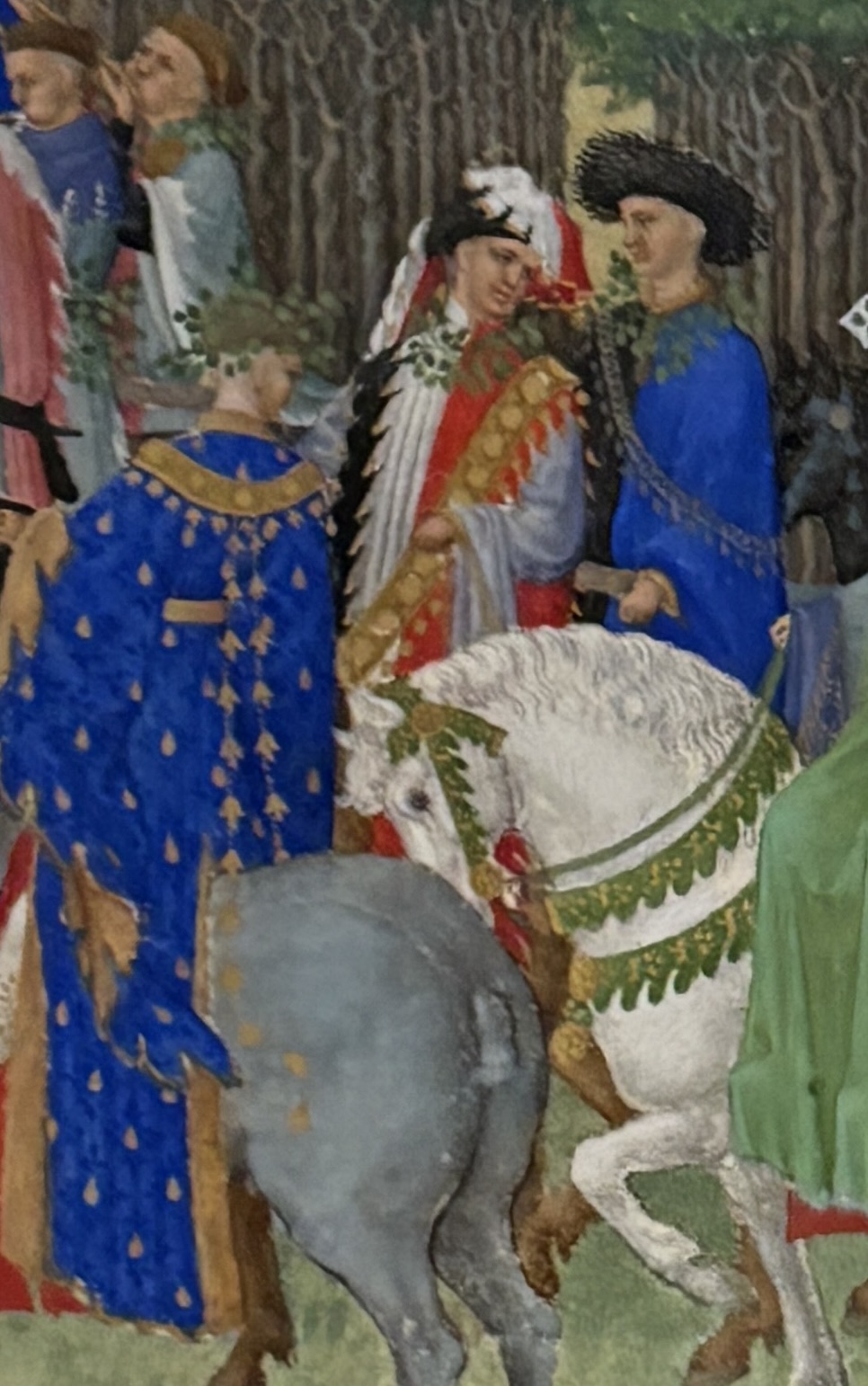 The men are no less luxuriously dressed, in fact, their clothes look every richer than those of the women. In the foreground, one man wears a gloriously deep ultramarine blue cloak decorated with what look like gold teardrops and arrow heads, and a rich, wide gold collar; he is looking towards another man wearing the colours of the King of France – half black and white and half red. It has been suggested that this could be the Duc de Berry himself. Green leaved garlands adorn the men as well as the women.
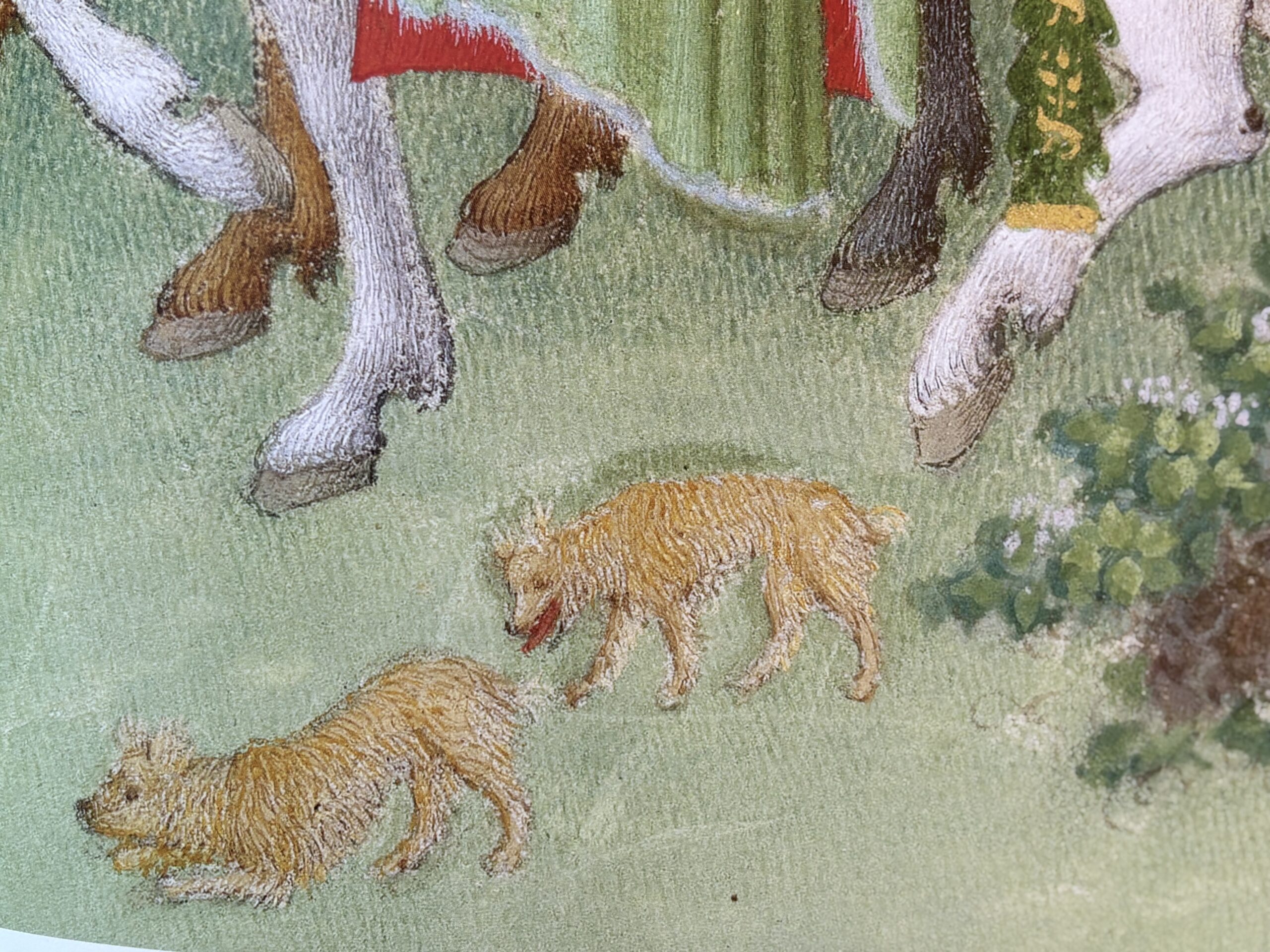 If it is the great man, then the two little dogs in the lower right of the picture will be the same ones as on his table for the Christmas feast (see here) Certainly they’d be a lot safer on a table top than they are here on the ground in too easy range of getting trodden underfoot by the horses!
 As with most of the images for each month, this one also features one of the Duc de Berry’s many castles and châteaux. This time it’s the Palais de la Cité in Paris, with the Sainte-Chapelle and the Tour de l’Horloge clearly visible in the background, and thus giving an invaluable record of the skyline of Paris in the 15th century.
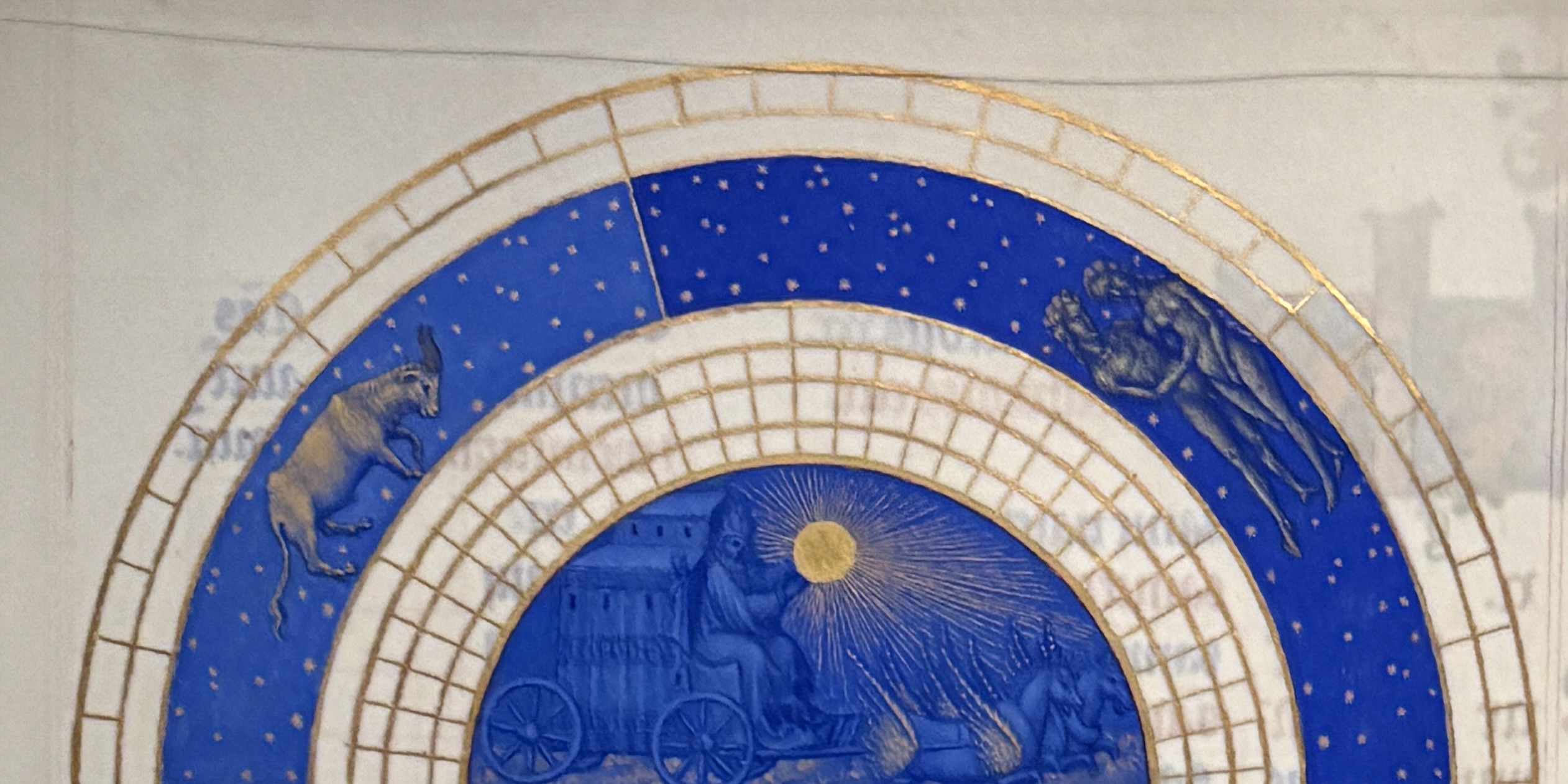 As with all these Labours of the Month pages, this is topped by a blue and gold semi-circle showing the astrological signs for this time of year. Here Taurus the Bull is giving way to Gemini the Twins, with the chariot of the sun being pulled by winged horses across the sky.
 Yet again, this is a real triumph of skill and artistry which underline the title given to this manuscript – the Très Belles Heures.
For more Labours of the Month from the Très Riches Heures of the Duc de Berry see here: July, August, September, October, November, January, February, March, April


