Author Archives: Patricia

A modern flagellum

IMG_0522Beating the sin out of your body with a mediaeval flagellum may have worked in those times, but to me, this is a shocking use of beautiful writing and wonderful animal skin. I saw a flagellum first in the old British Library, when it was still housed within the British Museum in Great Russell Street. There was a well-used wooden handle, and Biblical texts in a form of Gothic Black Letter written on strips of animal skin, which were attached to the handle. The skin was rather discoloured, which it would be if it had been used to beat the body.

enlargement of modern flagellumI thought that, following my theme of loving a lot of lettering that is 3D, I’d try my hand at making a modern flagellum. But what to write? Although I love the words of the St James Bible, I thought that to use biblical texts would simply be a copy. I then realised that there were words and phrases that seemed to be beating the living daylights out of the English language – pre-owned, meaning second-hand, faux, meaning fake, compact (with houses and flats) meaning tiny, economical with the truth, meaning lying. I also have a bit of a thing about verbs being used as nouns, and I’m sorry, but it’s the grammar police here, different from (not different to), fewer for numbers (rather than less than), and so on.

We had a great time one evening with our friends suggesting words and phrases, and then I set to. It may be flagellum, but I wanted to make it beautiful. So I chose some really creamy vellum, used Chinese red and black stick ink, and separated the individual words and phrases along each strip with a gold leaf dot on raised gesso. I marked out with pencil and a straight edge the strips on the vellum – the plan was to make long strips and fold them in half, and then attach them together – and set to. Once the gilding and writing were done I cut up the strips using a sharp knife and straight edge (not too clever with the raised and gilded dots, but there we are!), folded the strips in half and then sewed them all together with bookbinder’s thread.

I am not skilled in wood turning, but I know a man who is, our piano tuner! So we discussed the dimensions and he made the handle. I tried ramming the strips into the cup-shape in the handle but they didn’t stay there very effectively, so I then flooded the inside cavity with acid-free PVA, and it held.

Unlike the mediaeval flagellum which had been used and so the vellum strips were quite flexible, this vellum is stiff, and so, when displayed, each strip has to be separately attached to the backing (with white bluetac). I just wonder what people will think of this in years to come!

St Vitale, Ravenna – secret pens and ink pots

16436-san-vitale-basilica-ravenna-view-northRavenna is one of the most amazing places I have been fortunate enough to visit. I was so bowled over the first time we went there that this year we went again, and if you haven’t been yet, don’t leave it too long before you go! For me one of the best places was the Church of St Vitale, the patron saint of Ravenna. The building was begun in 526 and finished in 547 – an amazing feat of craftsmanship in just over 20 years.

It is octagonal in shape and is a mix between Roman styles (dome, shape of the doorways, etc) and Byzantine styles (the capitals to the columns and narrow bricks).

San Vitale RIt is the mosaics that are the most spectacular though to me, and perhaps the most famous is that of the Emperor Justinian and his court to the left of the high altar, and his Empress Theodora opposite him. Justinian is wearing a deep Tyrian-purple robe, dyed from a liquid which comes from the murex brandaris mollusc. Each sea creature gives only one or two drops and it’s been estimated that 12,000 molluscs were required to dye a single robe. It’s easy to see why the colour was restricted to the most important people and even Roman Senators had only a broad purple stripe on their white togas!

San VitThe Empress Theodora with her court is depicted on the wall opposite her husband, and she is dressed in a rich purple cloak, but this time hers is embellished with a gold pattern and figures processing at the base. As her hand reaches out to hold the gold and jewelled bowl, it pushes her robe aside to reveal a white dress with a magnificent gold thread and coloured border. Of course, all this decoration, the expressions on the faces, and the richly patterned dresses and headdresses are not painted, but are mosaics. The workmanship is simply incredible! Look particularly at the patterns on the clothes of the woman on the right in this picture.


Ravenna mosaicIt is interesting in such an old church to see within the mosaics, if you look closely, examples of writing equipment – perhaps an indication of the importance of the written word to Christians. The man to the right of Maximianus in the Justinian mosaic above is holding a jewelled book (more on Golden Books), but there are also images of writing paraphanalia. Here is John the Evangelist holding an open codex, and beside him on a little pedestal table is his quill, quill knife, ink pot, and probably an ink horn. Note the red tabs on the book which are just dropping down. These were used to secure the bouncy animal-skin pages when the book was closed. Quite a few manuscript books had hasps and clasps, though not all have survived still attached to the binding.


29205-san-vitale-basilica-ravennaIn this mosaic the Evangelist Luke is pointing to his symbol, the calf (though looking more like a full grown bull here!), and holding his Gospel. You can make out the hasps and clasps a bit better here. At his feet is what looks a bit like a hat box with a strap to carry it. In fact this was a container in which to keep scrolls, as you can see they are tightly wound and stacked vertically inside – and remember that all of this is made up of tiny pieces of tile.


San VitaleThe Evangelist Mark indicates a very ferocious lion as his symbol, and again, on a pedestal table, are his quill, quill knife, ink horn and ink pot.


San VitaleAnd lastly, here is Matthew with his winged man symbol. Perhaps rightly so as the first Evangelist he has both writing equipment and a box of scrolls. Note the lock on the front of his scroll box.


Golden Books – the Lindau Gospels and others

Lindau Gospels front coverIt is rare to get a ninth century book where the original jewelled cover is still attached to the book. The Lindau Gospels is one such. It was bought by John Pierpoint Morgan and was his first major manuscript purchase. The cover is simply amazing. The centre piece is Christ on the cross in gold, standing proud from the surface. Mourning figures, some with wings, are also in relief in the four surrounding panels. It is thought that below the arms of the cross are the Virgin Mary, John, Mary Magdalene and Mary, the wife of Cleopas (Cleopas was one of the disciples who met Jesus on the road to Emmaus. His wife was Mary, and, in John’s Gospel, she was named as one of the women standing with Mary at the cross). The sun and moon are represented above the cross. (A design point: having a centred design makes the whole thing too far down the cover – how I want to just push it all up a bit!)

Rear_cover_of_Lindau_GospelsThe jewels are just stunning – pearls in abundance, amethysts, jade, beryls, and what could be moonstones amongst others. The back cover is not quite so lavish, but wonderful in its own way. Silver and gold have been worked into interlace, similar to that in the Lindisfarne Gospels, and although the jewels are fewer in number, the enamel work in very fine indeed. The additions of two vertical strips at either side edge indicate the the back cover was not made for this book. It is thought likely that the book was produced at the Royal Abbey of St Denis just outside Paris.

There is a discussion of the book cover in detail here.

462px-codex_aureus_sankt_emmeramThe Codex Aureus of St Emmeram (Golden Book) is also a ninth century book. The date for this book is quite precise – 870, and it was produced for the Holy Roman Emperor Charles II (the Bald), at his Palace School, probably again at St Denis. There must have been some exceptionally skilled craftspeople around at that time! It is a large book at 420×300 mm. Again there is a central cross shape, but this time the figure is Christ in Majesty holding a book where the text is clear and reads: ‘I am the way, and the truth…’. Around the central figure are the four evangelists’ symbols, and there are images of Christ’s miracles in the four L-shaped panels. It is thought that the monks Liuthard and Beringer wrote the book and to see some inside pages of their work click here.

Dodex Aureus of FreckenhorstThis is what some jewelled book covers are like now. This is the Codex Aureus of Freckenhorst, which is an 11th century gospel book. Although a few mother-of-pearl remains, with some pieces of jade, turquoise and amethyst, most of the stones have been prized out with a knife, which does leave us a peek at the wooden board forming the structure of the cover below. The central ivory is particularly exquisite. Christ is in a mandorla (this is the shape of two circles overlapping and so is where the circle of heaven overlaps with the circle of earth – which is where Christ is situated), holding a book, which again emphasises the importance of the Word at this time.

Stockholm Codex AureusA note at the beginning of the Gospel of St Matthew in the Stockholm Codex Aureus tells us that the book was stolen by the Vikings, no doubt for its precious cover, but was bought back ‘with much gold’ and presented to the church. It is quite likely that when it was realised that this was a book not a box, the cover was ripped off and the Vikings were then quite happy to sell the inside of the book on.

Note at Stockholm Cod AurYou can just about make out the note written above the magnificent ‘Christi Autem’ and then continued at the bottom of the page. It explains that Earl Alfred, from Surrey, and his wife Werburg bought the book from the ‘heathen invading army’. The inside lives up to its name of Codex Aureus. A mid-eighth century book, it was probably produced in Canterbury. Pages of dyed purple vellum with gold, silver and white pigments are followed by undyed skin with black, red and gold. Wulfhelm the goldsmith is named, so too are Ceolhard , Niclas and Ealhhun, who were probably the scribes and illuminators.


St Cuthbert’s Gospel – a rare jewel

St Cuthbert's Gospel 1St Cuthbert’s Gospels is one of the most covetable books I have ever had the privilege to see close up. Being within a foot or so of a seventh-century book that was found in the coffin of the important Northumbrian saint, St Cuthbert, was an amazing experience. When the coffin in the shrine of St Cuthbert at Durham Cathedral was opened in 1104, the book was found placed there with other objects such as St Cuthbert’s pectoral cross and precious textiles. It fits in the hand, as you can see on the right, and could so easily have slipped into my pocket if no-one had been watching!


St Cuthbert Gospel, coverWhat is quite remarkable about the book is that it is still in its original binding, and as such is the oldest European bound book. Deep red leather covers wooden boards. On the front cover a scroll pattern and straight lines (which make a neat frame) have been outlined, possibly with cord or even carved wood which was then glued on to the cover. This meant that, when the red leather was pasted on, these areas became raised from the surface. In the surrounding border and in the upper and lower blocks, an interlace pattern has been indented and also coloured; the yellow pigment is more obvious than the blue in this photograph.


Coptic bindingThe gospel is a coptic binding, which means that, rather than the sections of folded pages (gatherings) being sewn on to wide tapes and these then attached to the covers, the gatherings are sewn with thick thread in a sort of chain stitch (see right) and these hold the sections of the book together and are then attached to the wooden boards (as you can see on the right). This is how codices (books as we know them) were first made and they rarely have covered spines. The wooden boards of this book (right) – made when I was at college – would then have been covered by red leather and tooled to get the effect of the St Cuthbert Gospel.

Coptic book openThe binding is particularly flexible, as you can see again here with that college-made book. When I was being filmed writing the first page of this book at the British Library I was able to speak to the conservation book binder, and he said that the spine is still completely flexible, and it would be possible to turn the book round completely on itself so that back and front cover could touch – of course he hadn’t done this!

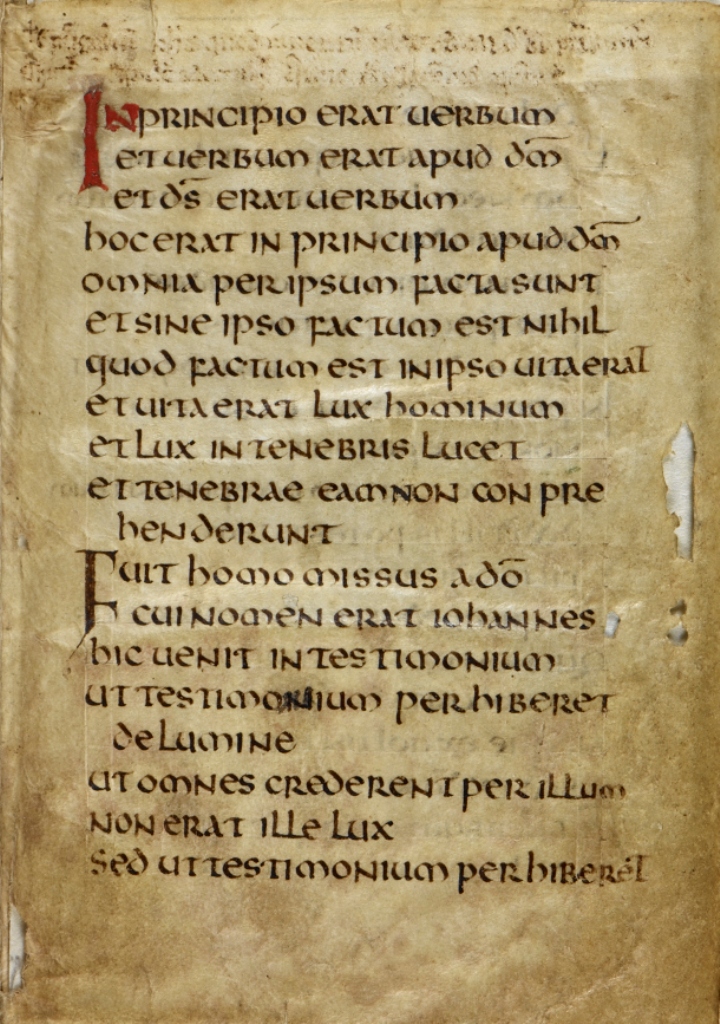
St Cuthbert Gospel, f. 1Inside the book the text is written in the lettering style of Uncial. There are very few ascenders and descenders and the letters are essentially majuscule. The Gospel of St John starts with a long versal I in red (versals are letters where the thicker strokes are constructed out of two or more pen strokes, rather then simply changing the nib to the thickest angle and making one stroke); this letter is followed by a smaller letter N. The red ink has smudged slightly over the years. The rest of the text is in a dark brown ink. As with most scribes when writing an important manuscript, the first few words are rather tightly written, but by line four things are more relaxed, although it is only in the second paragraph that the scribe really gets into his stride. Notice, too, that the first two words (In principio – In the beginning…) are written with more pen nib angle changes than for the remaining Angled Pen Uncial script. This page, too, because it is the first page, is more discoloured and worn than the rest of the book.

St Cuthbert's Gospel 2And the remarkable aspect of this book is how even and pleasing on the page the text is. There is considerable consistency to the lettering, and it is quite easy to read with very few contractions, unlike some manuscripts written centuries later. Look out for Lazarus at the end of the second line on the right, for example (obviously this page is about the raising of Lazarus). It is written per cola et commata, that is the length of the line is determined by the sense of the text, and a subsequent clause starts on the next line. You may also be able to see the fuzzy ink indicating an erasing at the start of line 8. The scribe has scratched out whatever it was written in error and the vellum skin is rougher at this point. Look out, too, for where the ink is running out and so the scribe fills his quill for the next letter. In the second to last line the letters TT in quattuor have had additions to the start of the serifs on the crossbar (look closely, and see that the crossbars are fainter at the beginnings and ends, and so the scribe has added tiny strokes with a full quill of ink to emphasise them).

Look also at the free Calligraphy Clips page on this website for how to write this style of lettering (it’s the latest set I’ve put up so you’ll need to scroll to the bottom).

photoWhen the St Cuthbert Gospel was saved for the nation, the British Library made a film to celebrate this, and I was lucky enough to be asked to show how the first page was done. I tried to be as ‘period’ as I could. I knew that a plastic ruler wouldn’t quite cut the mustard, so I found a piece of wood to draw the lines (rather large, but it was real wood), and fished out an old bradawl from the tool box to score the lines. There is no sound on this clip, but it does show how the page would have been set out, and how the letters were written.

The book is now at the British Library, and they were thrilled to own it now, as is evident on this BBC World News item with Dr Claire Breay (a couple of seconds in on this clip). It is usually on display in the British Library, and for many years it was shown closed – very frustrating to we scribes! Conservation experts have indicated that it can now be displayed open so everyone can have a chance of studying the wonderful script for themselves.