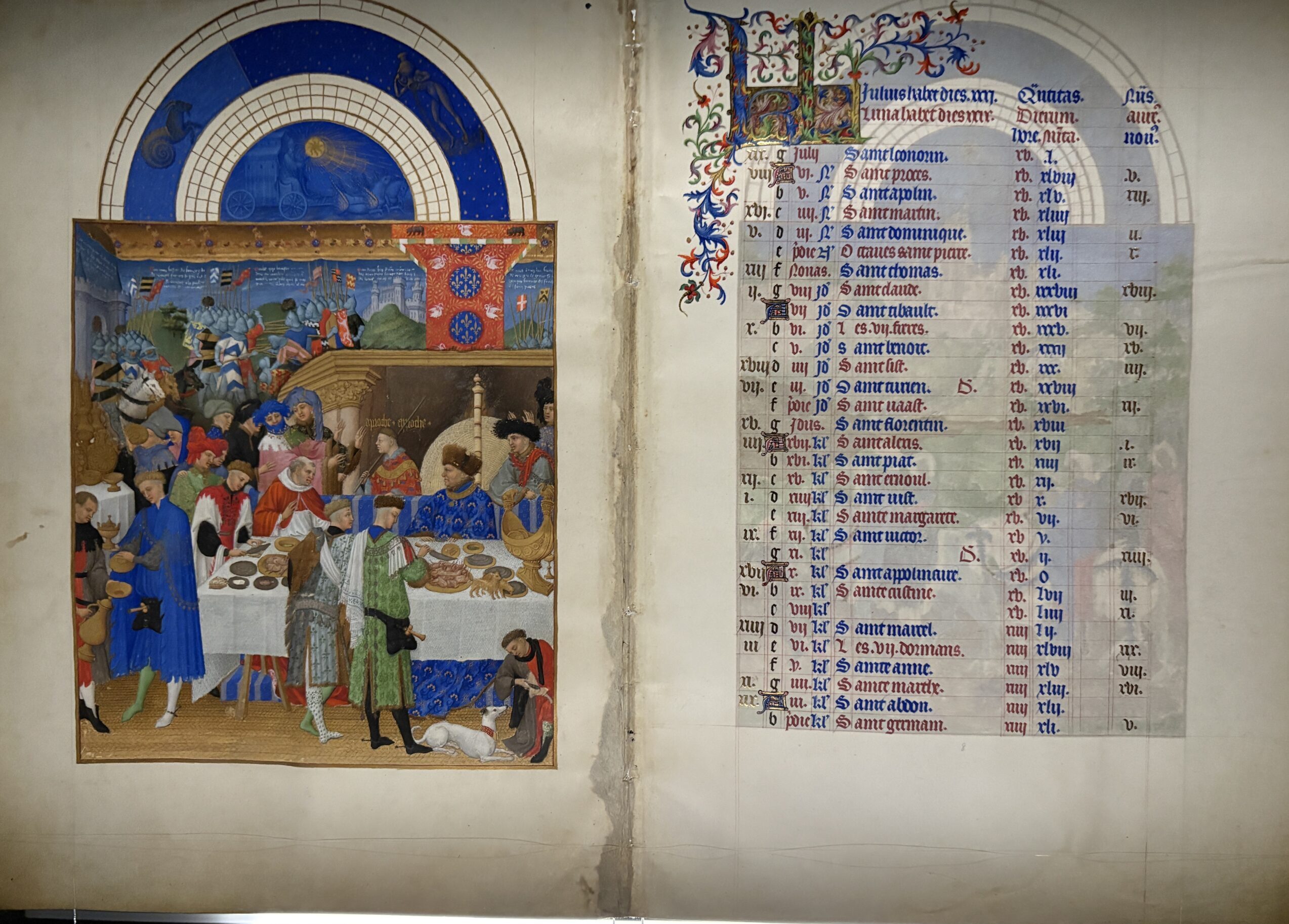
January in the Très Riches Heures of the Duc de Berry

January Labour of the Month in the Tres Riches Heures of the Duc de BerryChristmas wasn’t really celebrated in historical times as a major festival, that was left to the New Year when gifts were exchanged, this was called the étrenne, and where the Duc de Berry was concerned, gifts were lavish and expensive. The Labour of the month for January in many Books of Hours was feasting and warming by the fire. There are some miniatures where people have taken their shoes off so that the heat from a fire is more effective.

January in the Tres Riches Heures of the Duc de Berry - table with foodJean, Duc of Berry, is no different, but it is on a different scale altogether! Here in this magnificent colourful image for January, Three men are serving meat at the Duc’s table laden with food, using large knives to do so.

It has been suggested that the two men with their backs to the viewer are pages as they have white linen napkins, one with his over his shoulder, and the other across his body. They may also be to hand to pass to the Duc de Berry when he has rinsed his hands removing the grease from the meat. One of them is wearing spurs, even indoors, indicating that he is ready at any moment to fight for his master.
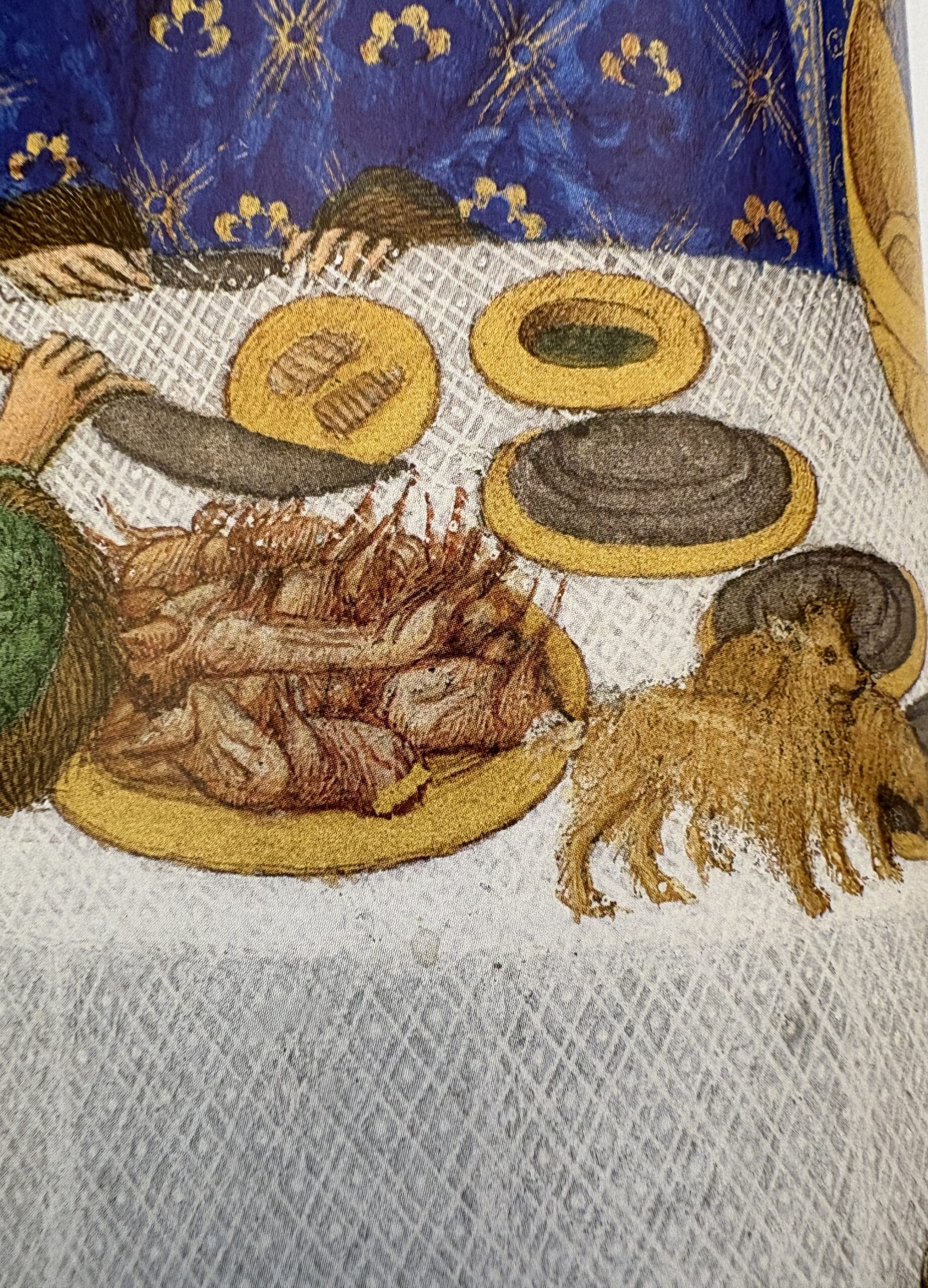
January in the Tres Riches Heures of the Duc de Berry large plate of meatThe Duc’s table, covered by a large white linen cloth, is laden with food including chickens and suckling pigs on a huge platter; they are carved by the green-tuniced figure almost in the centre of the image. Some of the carved meat is already on the Duc de Berry’s golden plate. Next to him is his finger bowl to rinse his greasy fingers, although they seem remarkably small as they rest on the table in front of him.


Two little lapdogs are standing on the table with their backs to the chickens and suckling pigs. Although they have their own golden plate, it is pretty unlikely, if my experience of dogs is anything to go by, that they would ignore this huge mound of meat!

The Duc’s white greyhound, meanwhile, is lying down on a rush-matting-covered floor waiting patiently for the kneeling man in sombre clothes enlivened with a red scarf to cut some pieces of meat for him.


January in the Tres Riches Heures of the Duc de Berry firescreen behind the DucThe other usual activity for January’s Labour of the Month is warming by the fire and it is no different in this image. Although he is wearing thick robes and a fur hat, the Duc is here sitting in front of a roaring fire protected by a woven circular firescreen supported by a central carved light wood pole. The flames from the fire can be seen above this. A rush (?) screen such so close as this to the Duc and the fire doesn’t seem that sensible with the sparks from the fire being thrown out!


January in the Tres Riches Heures of the Duc de Berry possibly a Van Limbourch BrotherOthers in this image are wearing fur hats and the two behind the Duc, both shown above and in the enlargement here, are thought to be two of the Van Lymborch Brothers. The one nearest to the Duc is leaning rather familiarly on the back of the Duc’s blue-covered bench. Both are wearing matching grey robes, with the one in front having a fur collar and a dark grey or black red tipped scarf, and the one behind warming his elegant fingers by the fire.

The detail on the woven firescreen can be seen better here, with the radiating ‘spokes’ and carefully woven weft, and the change of pattern nearer the edge.

January in the Tres Riches Heures of the Duc de Berry golden saly cellar in the shape of a boatThe 1st of January was also a time for gift giving, and it is possible that the magnificent golden salt cellar, to the right of the image, was one such. It is in the shape of a boat and at one end is a figure of a bear, the Duc’s symbol. Between 1401 and 1416 the Duc commissioned 119 objects, gave 231 gifts, and received 358 gifts from 136 different people – some gift giving, and the gifts were probably more than a pair of socks!!
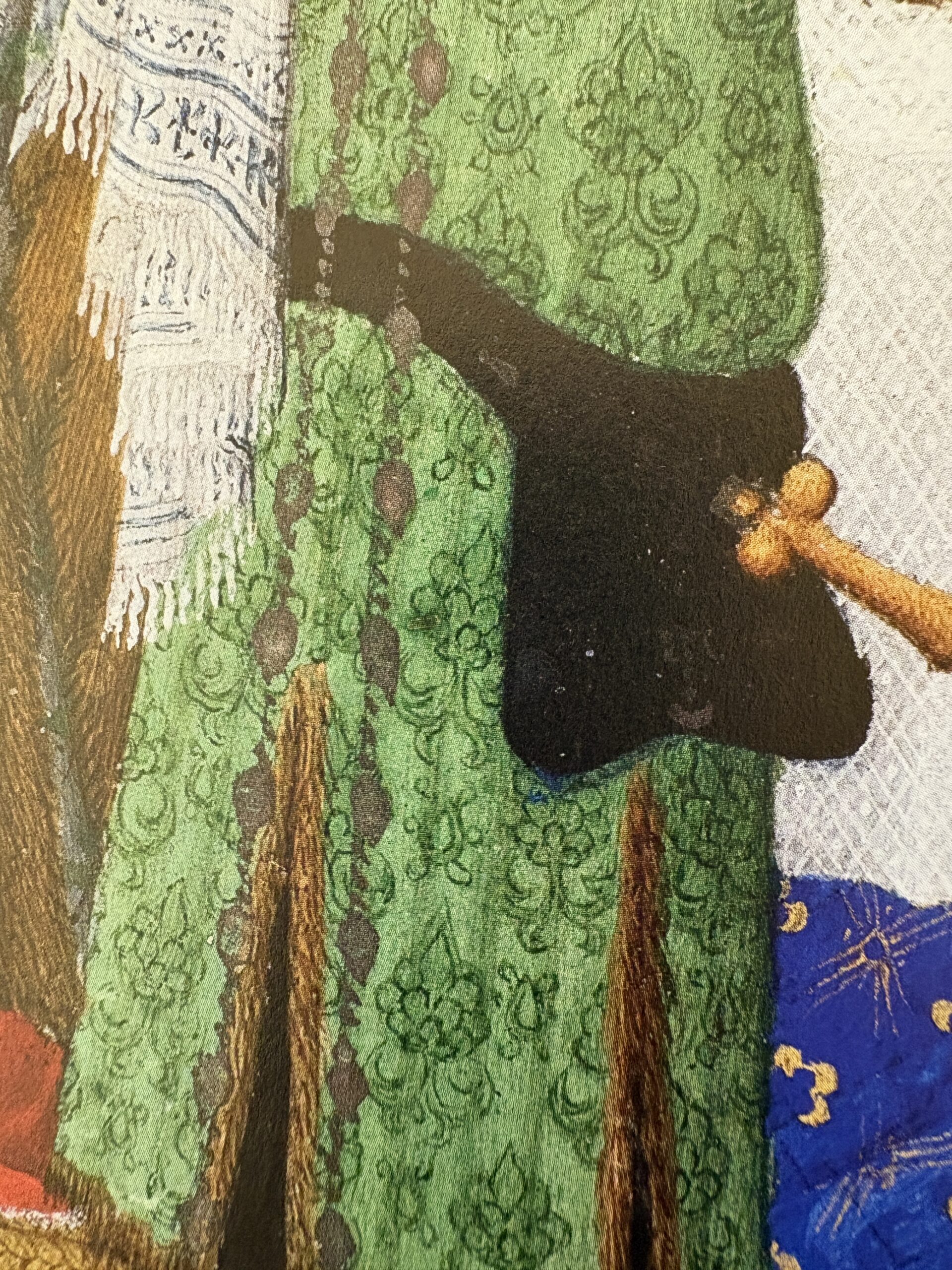


January in the Tres Riches Heures of the Duc de Berry enlargement to show textile detailIn this enlargement of the man almost in the centre of the image, the lavishness of the court dress and excellency of skill of the Van Lymborch Brothers is clearly seen. His tunic is lined with brown fur and the thickness of it can be seen in the way that it hangs and the slight bunching above his black belt – although, of course, this could also be due to the generosity of the Duc’s table! A delicate darker green pattern covers his tunic which is shown slashed in two places, and there is a gold chain dangling from an elaborate collar hanging right down to the hem. The grey-blue pattern, fringing and folds are clearly depicted on the linen napkin which is draped over his shoulder.

January in the Tres Riches Heures of the Duc de Berry enlargement to show textile detailSimilarly, the man next to him has a fur-lined tunic which is slashed but it is light and dark gray in vertical sections this time with a green leaf pattern overall. His wide, rather low slung belt is carefully painted and long tassels hang down from it. Just shown is his dark grey fur-lined cloak folded carefully over one shoulder.
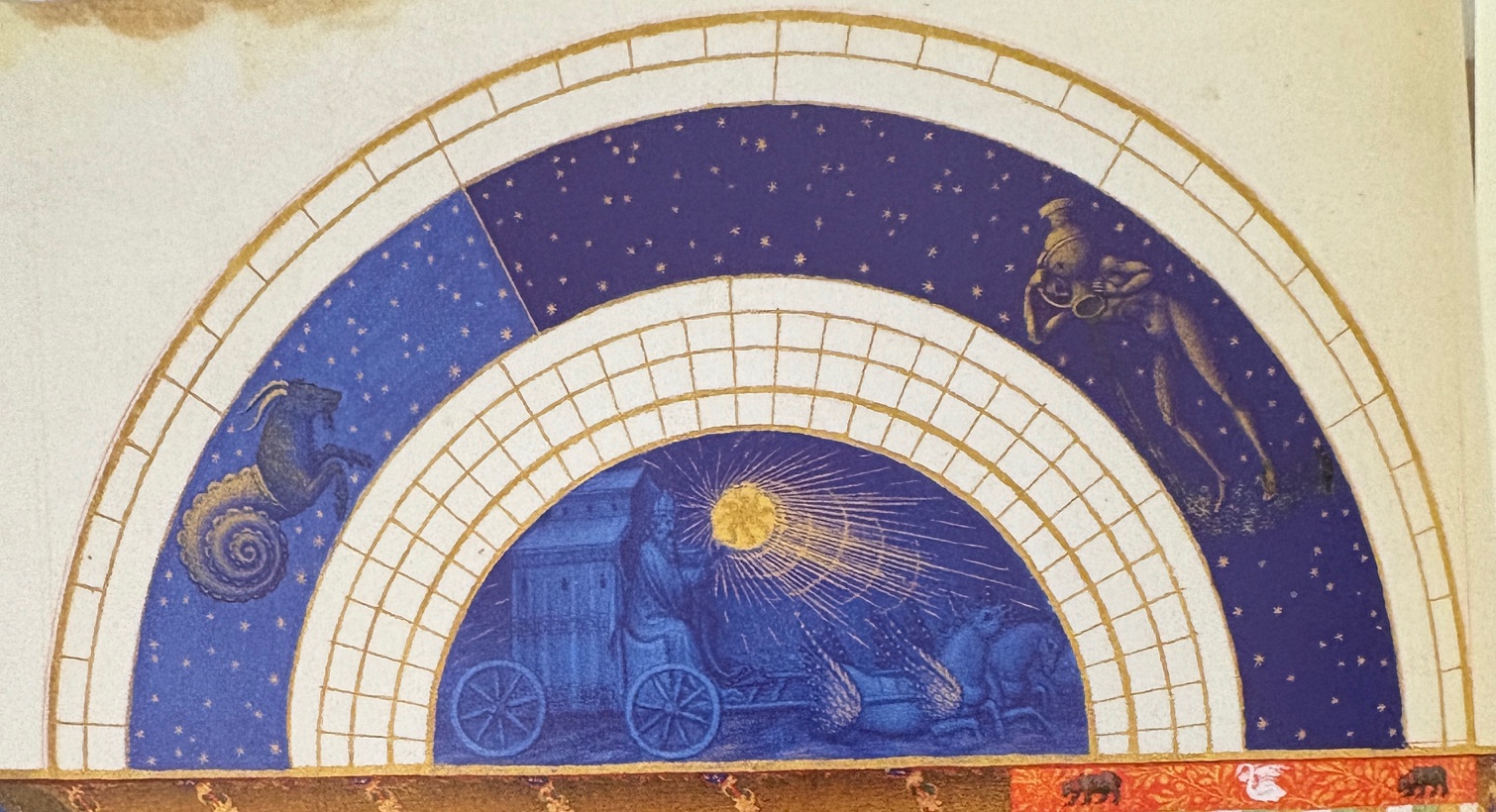


January in the Tres Riches Heures of the Duc de Berry enlargement to show Zodiac detailSimilar to the other calendar pages in this Book of Hours, this page is topped by a deep blue, ultramarine, semi-circular depiction of the Zodiac at this time with Aquarius the water carrier following Capricorn. The sky is studded with shell gold stars, and, in the centre of the semi-circle, the sun in its winged chariot pulled by four horses relentlessly moves across the sky.

January in the Tres Riches Heures of the Duc de Berry to show feastingThe exceptional skill of the Van Lymborch Brothers results in this tour-de-force which must have delighted their patron, the Duc de Berry, when he opened this book.

Other calendar pages are here: and February NovemberJulyAugustSeptember, October and February

For The King on the Occasion of the Coronation

It’s not often that you’re asked to carry out a commission for The King to be presented to mark His Majesty’s Coronation, and it was such a privilege to be asked to do so. It was also a special privilege to be able to propose texts rather than this being prescribed. At the time of this request I was looking into suitable extracts for my latest book ‘The Art of the Scribe’ (published Spring 2025), and this quotation from Shakespeare – John of Gaunt’s speech from ‘Richard II’ seemed most apt. Starting with the phrase ‘This royal throne of kings …’ and with other appropriate regal references in the speech as well – it matched the occasion. (Admittedly, John of Gaunt is lamenting the decline of the realm under Richard II, but that section wasn’t included!)


Such a piece needed a lot of thought and preparation and I was keen to ensure that as many pertinent references were made. First, of course, it had to be on stretched vellum, and a beautiful skin was selected by William Cowley – the most perfect ivory-white. Then, without question, it had to be in gold – yellow shell gold – and with pure leaf gold on gesso as part of the composition. I tried it in my go-to Italic script and wrote out the whole passage as here.


This, though, was too ‘blocky’, and, on re-reading, it seemed that the speech was reaching a crescendo at ‘This blessed plot, this earth, this realm, this England’ (you can almost hear the actor’s voice rising in volume until the last two words are almost shouted). But writing each phrase on a separate line broke up the design too much.


In the end I decided to write the four phrases in two lines, with ‘this England’ in capital letters. This seemed to work better. However, for this piece italic just didn’t seem right, so I went back to a script developed during the reign of another King Charles, actually a Holy Roman Emperor, that of Caroline Minuscule used in many manuscripts during the time of Charlemagne in the ninth century. But how would it look written in gold? I tried out the first line on an offcut of the vellum being used and it seemed to be just right.

The gesso crown was rather tricky as it was so small (about 1·5 cm) and only a nodding representation could be made to the pearls atop the arches of the crown, and the fleur-de-lis and crosses patey which rise from the gold rim. The different shine on this part of the piece echoed but also contrasted that of the shell gold.


It was framed in Sandringham oak – wood saved from an ancient oak tree in the parkland which would have resonated with His Majesty for whom, we know, it is a very special place. The letter received back by Gallyon indicated that King ‘was touched to receive this beautiful piece of commemorative art’. And I felt that it was a real honour to have been asked complete it.

Mediaeval decorated letters to colour

I’ve been lucky enough to have worked closely with the British Library for what is now decades. Many years ago I was helping the Education Department which had a lot of school visits. The problem always with such visits is how to occupy those who finish any set tasks quickly before the rest of the class. I suggested producing a series of outline drawings taken from illuminated and decorated mediæval manuscripts that could be coloured in, and then produced six of them.

Having a clear-out recently, I came across them again, and thought that they could be shared with a wider audience, hence this blogpost. They are copyright, but free for personal and educational use, simply click on the picture/link below for a high resolution pdf to print out; they’re sized for A4.

I’ve copyrighted them because they mustn’t be used by anyone or an institution to print out or use in a publication and make money from them.

Please, though, feel free to print these outline letters for your own use, for children and grandchildren, for courses, and for classes.

As the British Library’s website, including the digitised manuscripts, is still not completely available, colour images are here if possible, otherwise black and white photos or similar images are posted.

Copy the original colours if you wish, or go freestyle – they’re your letters to colour, so your choice.

The first is the magnificent letter B from the Ramsey Psalter (BL Harley 2904).


And the outline letter is here, click on it to download the high-resolution PDF:

Worksheet 1

David and Goliath, mediaeval manuscriptI wasn’t able to get a coloured image of the miniature from BL Harley MS 2895, but this is from a similar period and indicates the colours that would be used.


And the outline letter is here, click on it to download the high-resolution PDF:

Worksheet 2

Again, no colour copy copy of the letter ‘N’ from the actual manuscript, but a black and white image is here, and below it a similar letter in colour:


And the outline letter is here, click on it to download the high-resolution PDF:

Worksheet 3

Yet again there are no colour images available for the York Psalter; here it is in black and white:


And the outline letter is here, click on it to download the high-resolution PDF:

Worksheet 4

Hosea from the Worms Bible:


And the outline letter is here, click on it to download the high-resolution PDF:

 Worksheet 5

Finally, this magnificent lettering and decoration from the Lindisfarne Gospels:


And the outline letter is here, click on it to download the high-resolution PDF:

Worksheet 6

The Art of the Scribe

‘The Art of the Scribe’ is Patricia Lovett’s latest book published by the British Library in Spring 2025.

It is an informative as well as a practical book and focuses on the seven major periods of manuscript production in terms of script and page illumination and decoration – Uncials, Caroline Minuscule, English Caroline Minuscule, Gothic Textura (Black Letter), Bâtarde, Humanistic Minuscule and Italic. At the end of each of these chapters are three graded projects – foundation, intermediate and advanced – with clear photographs and step-by-step instructions covering layout and design, illumination, using shell gold, writing is a circle, and also in a spiral, as well as painting various manuscript styles.

The second part is comprehensive and detailed and includes materials, tools and techniques, covering everything from paper, vellum and parchment, quill curing and cutting, oak gall ink, making and using gesso and then gilding with leaf gold, painting a mediaeval miniature, and so much more; modern tools and materials are covered as well. There are also sections on analysing scripts, serifs, layout and design, spacing and book binding.

This book is the result of decades of learning, researching and perfecting the craft.

The Art of the Scribe

‘The Art of the Scribe’

The Art of the Scribe cover‘The Art of the Scribe’ is the latest book published by the British Library in Spring 2025. It focuses on the scripts and the illumination and decoration used in the seven major periods of mediæval and Renaissance book production. Each of the seven chapters includes information about manuscripts of those times, what they were, who they were produced by – the scribes and illuminators – and the people associated with the books. There is also a detailed second section on tools, materials and techniques for calligraphy (including analysing texts, spacing of letters, words and lines, layouts, and serifs), illumination, painting, and simple book binding.

The Art of the Scribe, a pageFor each of the seven writing styles there are clear exemplar letters with guides for writing each one – here are Uncials as in the St Cuthbert Gospel in the British Library. Both the alphabet is shown as well as the letters arranged in families that have similar strokes – this makes learning and practising the letters much quicker.


The Art of the Scribe, a pageIllustrations are large, often taking up the whole page as here – a page from one of the huge bibles produced at the monastery of St Martin, Tours, in France. The script is Caroline Minuscule and is a lovely dancing script, very legible, and wonderful to write.


The Art of the Scribe, a pageAt the end of each of the seven chapters are three graded projects – foundation, intermediate and advanced. This is a favourite from Caroline Minuscule – a zig zag or concertina book using text from Dorothy Wordsworth’s ‘Grasmere Journal’ describing the walk when the ‘host of golden daffodils’ was seen. The illustration along the bottom matches the text, with a few daffodils to start with and then more and more.


The Art of the Scribe, a pageThe second section consists of a comprehensive consideration of materials, tools and techniques; for tools and materials – what is needed, how to use them and how to take care of them. The pages here are how to mix gouache for ink and paint and how to mix repeat colours.


The Art of the Scribe, a pageThis double spread is about vellum, how it’s made, types of skin – vellum and parchment – and the differences in thickness in the skin which affects the final result in use.


The Art of the Scribe, a pageIncluded in the section on tools is a section on quills, quill curing and quill cutting – all clearly illustrated with excellent photographs by the British Library photographer, Jonathan Vine, and with step-by-step instructions. Just visible on the left are the final steps for laying gesso, adding gold leaf (illumination) and painting a mediæval miniature.

Here is a sneaky peek inside the book showing the seven chapters – Uncial, Caroline Minuscule, English Caroline Minuscule, Gothic Textura (Black Letter), Bâtarde, Humanistic Minuscule and Italic – and also the second section of detailed information.

‘The Art of the Scribe’ is available from the British Library bookshop, and I have a limited number of copies for sale where I am happy to write in a name calligraphically; contact me through this website for this and for the cost of p+p (it is a heavy book, so that isn’t cheap!).


Stanford University Calligraphy Collection – Susie Leiper

From ‘Bheinn Naomh’ by Kathleen Raine, Chinese ink and graphite on Chinese paper, 45 x 30 cm, £750 $1000

Entries are coming in for the Stanford University Calligraphy Collection, so if you’re a calligrapher or hand letterer at the top of your game, don’t miss out on being part of this amazing new collection of the best of the world’s calligraphy (in the western alphabet style – at the moment!). You can apply here. The latest work that’s been received has been from UK artist and calligrapher Susie Leiper. Her style is free, creative and precise, and her work has an energy and vitality to it as can be seen here.


And here:

Dry lightning

From ‘Demons and Men’ by Robert Bringhurst

Ink and resist on Chinese paper, 30 x 17.5 cm


Susie makes the most delightful books, full of invention and surprise. Here the use of colour, shapes and lettering are not only fascinating and intriguing but beautifully executed.

Vision of a city

Text from Ezekiel 40 – 48, King James Bible

Artist book: oil, graphite and casein paint on card; silk covers,

21 x 9 cm closed

Close up here:


And then this is:

A sense sublime

From ‘Tintern Abbey’ by William Wordsworth

Oil, casein paint and ink on board, 66 x 67 cm


With a detail here:


It is wonderful that supreme artists such as Susie are part of this incredible Collection and the plan is that all will be online. But, again, if you’re at Susie’s standard, make sure you don’t miss out in being included.

The Stanford University Calligraphy Collection and Gemma Black

The Stanford University Calligraphy Collection is a remarkable initiative by Dr Benjamin Albritton in creating a unique collection of the calligraphy and lettering of the best calligraphers in the world. This collection is particularly significant because it is at one of the most prestigious universities already known for its focus on letters and lettering in all forms. This is truly an amazing project and all calligraphers and letterers at the top of their game are invited to take part; details here. One of those who has completely embraced this project is one of the prestigious judges, Gemma Black from Australia.

One of her ambitions since early days has been to write out the United Nations Declaration of Human Rights. This was a daunting task, but in her characteristic inspiring manner Gemma produced a series of stunning separate pages, each page devoted to one declaration.


She devised a particular and unique style of letterforms, majuscules, or capital letters, with elements of Uncials, producing a rhythm and flow to the written sections. The text is remarkably legible despite the lines touching with no space between them and with letters nested or sharing strokes.


The illustrations consist of ‘figures’ of differing heights and shapes in various subtle colours placed on a straight line with a delicate wavy shape below. These tie the whole series of separate sheets together into one harmonious whole. Gemma is shown here; behind her the series of individual declarations have been hung creating what must have been a wonderful exhibition.

To see more of this amazing body of work, click here, and here.

Calligraphy and Illumination Courses 2024

IMG_1953 2I am teaching two one-day courses at Sevenoaks in Kent (35 minutes by train from Charing Cross in London, and about 10 minutes from Junction 5 of the M25) in autumn 2024. The course on Saturday 21st September is ‘Quills and Calligraphy‘ and will be for both beginners – those just starting calligraphy – as well as improvers – those with some experience. The day will focus on Gothic Black Letter/Gothic Textura script. The course includes cutting a quill from a feather, and preparing a piece of vellum for writing and then writing a name on it with the quill.

DSCF0827Sets of 9–10 printed A3 sheets are provided for everyone on the ‘Quills and Calligraphy‘ course; these include the background and history of the script as well as principles of calligraphy, with exemplar letters and also ready ruled sheets showing the letters with individual strokes and direction arrows for construction, and then space to practise them (see image here). The handouts can be taken home as an aide memoir and also to continue practice.

IMG_1954The afternoon starts with cutting quills from feathers. This is carefully explained and demonstrated with everyone then cutting their own quill to use on the course and take home. A small piece of vellum will then be prepared for writing and a name written on it.

IMG_3425The ‘Illumination Masterclass‘ is on Saturday 5th October, and again is for complete beginners as well as those with some experience. Participants can choose from a limited selection of animals from bestiaries; this choice is restricted because the aim is to finish the painting in one day and that won’t be possible with complicated miniatures, however, there is some flexibility. Vellum is prepared for painting, and a tracing of the miniature transferred using traditional materials. A modern adhesive is used as there is not time on one day to use gesso; this is used on the three-day courses each May (see here). Real 23·5 carat gold leaf is applied to the adhesive to make it glisten.

IMG_4986Techniques of mediæval manuscript painting are explained carefully, and gouache paint with fine sable brushes are used to complete the image.

For both courses, demonstrations are live streamed to a large TV screen so everyone can see and there is no crowding round the demonstrations. Classes are limited to six participants allowing plenty of time for individual tuition.


IMG_4968Courses take place in a large bright room with plenty of light and individual adjustable table lamps for each person.

All refreshments throughout the day are provided including tea, coffee, home-made biscuits, and a light lunch.

The courses are held just outside Sevenoaks in Kent (UK). There is plenty of onsite parking, and for those travelling by train there are taxis at Sevenoaks station; we can pick up and take back four people.

To apply and details of cost etc please contact me through my website.

Trajan’s Column II

IMG_0281Trajan’s Column in Rome, completed in 113 AD, commemorates the victory of the Emperor Trajan over the Dacians. It is stunning when viewed in real life as it towers over the ruins of Trajan’s Forum and Market, being 98 feet (30 metres) high. The main part of the column consists of a frieze in bas relief which shows in great detail the preparations, movement of troops and battles that took place before the final victory, with Trajan, not surprisingly, being the tallest of all the figures in the column. There are 20 drums in all around which the figures wind, each drum weighing about 32 tons. It truly is a magnificent example of Roman engineering.


IMG_0262It is the base of the column, though, which is most interesting to calligraphers and letterers because it shows exquisitely carved Roman Capitals, regarded by many as the purest examples. It has been only recently (post written May 2024) that it has been possible to get anywhere near this part of the column to view the lettering.


IMG_4762An exhibition in spring 2024 at the Coliseum detailed how the column was constructed. Huge blocks of Carrara marble were moved from the quarries in Lunigiana sliding on wooden poles and being pulled by a team of oxen.


IMG_4764The stone drums were shaped into circles and the inner staircase cut as well. What is amazing is the accuracy of each block which had to fit on the next. The masons also had to allow for the fact that to make the columns look straight, there needed to be a swelling just below half way. This is explained in a blogpost on this website here. The huge round blocks were then loaded on to ships using a system of pulleys and a lot of labour as shown here.


IMG_4767 2Once at the forum, they needed to be put into position. The stone blocks were far too heavy to use a simple system of pulleys, and so a tower was built as here.

Either side of the column were two libraries, one for Greek texts and one for Roman, with bookshelves to store the scrolls. It was possible from balconies on these buildings to view the carvings spiralling round the column close up.


IMG_4771At the base of the column during construction was a huge wooden treadwheel. A similar one is shown carved into the family tomb of the Haterii. During the reign of Domitian (81–96 AD) Haterius was working on the construction of buildings and would have used a treadmill as the one carved on his tomb. The treadwheel had 5 men inside and ropes held by more men outside acted as brakes. There were two parallel wide poles creating the crane’s mast between which was the wheel’s axle; this all made up a strong block and tackle system.


IMG_4768 2This is shown more clearly here. The sheer mass of the wood being used for construction is amazing, and also the strength of the men using this machinery.


IMG_4737The spiral stone staircase carved inside the blocks led to the top of the column where there was a viewing platform. It must have been quite a sight, climbing the stairs and reaching the top for a view over Trajan’s Forum and the main Forum itself!


IMG_4812But, of course, it is the carvings on the outside of the column that are the true stars! Twisting round the column, with no allowance given from one stone drum to the next, a narrow carved line stands proud and separates the scenes one from another.


IMG_4823Here preparations are being made for the battles, with Neptune looking on benignly, no doubt giving his blessing to the campaign. The detail on the clothing, the wooden ships, the horses, a wooden bridge and building walls is really wonderful.


IMG_4821And even the base has the same care and attention to detail, with enviable precision of carving. Note the carefully carved garland of individuals leaves, and the metal ‘scales’ on the cuirass in the middle.

It truly is one of the wonders of the ancient world, and still astounds today.


The Benedictional of St Æthelwold

6a00d8341c464853ef01a3fcaecb6f970b-500wiA benedictional is a book of blessings given by a bishop; some manuscripts, such as the Benedictional of St Æthelwold (904/9–984), are richly decorated with gold and colour. Unusually we actually know who wrote this particular benedictional – the scribe Godeman as he included his name in a poem, probably in shell gold, placed at the beginning of the book. The poem includes the fact that the book should be richly decorated in gold and colour, as below, as instructions were given:


6a00d8341c464853ef01a3fcaecb8b970b-500wi-1‘A bishop, the great Æthelwold, whom the Lord had made patron of Winchester, ordered a certain monk subject to him to write the present book … He commanded also to be made in this book many frames well adorned and filled with various figures decorated with many beautiful colours and with gold … Let all who look upon this book pray always that after the term of the flesh I may abide in heaven – Godeman the scribe, as a suppliant, earnestly asks this.’


CIMG3078The manuscript, written in Winchester, which was where St Æthelwold was bishop, is decorated in the  ‘Winchester style’. This includes borders of acanthus leaves intertwining around circles and vertical and horizontal lines. There is much modelling and the appearance sometimes is almost 3-D. There is lavish use of gold and pages are most striking, although it could be said that the illumination on occasion almost overpowers the text. This style is seen clearly here, a copy of the beginning of the Eadui Psalter written a little later than as the Benedictional but decorated in a similar manner. This page was prepared for the Anglo-Saxon Kingdoms exhibition at the British Library, 2018–2019. There’s more about the creation of this page on my website here. And a blogpost with short films on how manuscripts were made here, including a film of gilding and painting this page.

6a00d8341c464853ef01a73d69da35970d-500wiThe potentially rather overwhelming aspect of the Winchester style is shown well on this folio. This full page miniature shows St Benedict and is placed in the book just before the benediction for his feast day. It is rather difficult to identify the central figure surrounded as it is by the gold and colour, with heavy and elaborate decoration at each corner, looking a little like shield bosses, and ones almost as elaborate halfway down the side. There are, though, as instructed by St Æthelwold, many arches in the book!


Screenshot 2024-05-14 at 17.43.51The lettering in the manuscript is very similar to, but not exactly the same as the Ramsey Psalter (shelfmark: BL, Harley 2904). The latter was written around the same time, and both in Winchester; the Psalter was the key manuscript used by Edward Johnston for his Foundational Hand. It is rather intriguing to think that both scribes may have been sitting next to one another in the scriptorium, and writing the letters slightly differently, perhaps even comparing notes!

There’s more information on a British Library blogpost here and it will certainly be worth looking at each page when the British Library website is up and running (this blogpost written May 2024).